Join the 6,000+ professionals getting 9fin's news and analysis delivered straight to their inbox — sign up for The Memo US newsletter.
The buyout of Electronic Arts is the biggest LBO in history, and it’s backed by a whopping $18bn of debt. The stakes are high, so there’s a lot of pressure on the Silver Lake-led sponsor group to make the numbers work — and we got an inside look at their plan.
As lead underwriter JP Morgan gears up for this huge debt syndication, which will involve loans and bonds across both euros and US dollars, details are starting to emerge.
According to a pitch deck obtained by 9fin, the sponsors’ growth plan for the company includes turbocharging its famous EA FC franchise (formerly known as Fifa), reviving the Battlefield brand, and ramping up in-game advertising.
Perhaps inevitably, the plan also includes the utilization of — you guessed it — AI technology to improve the company’s range of products. But first, here’s what the deck says about financial projections:
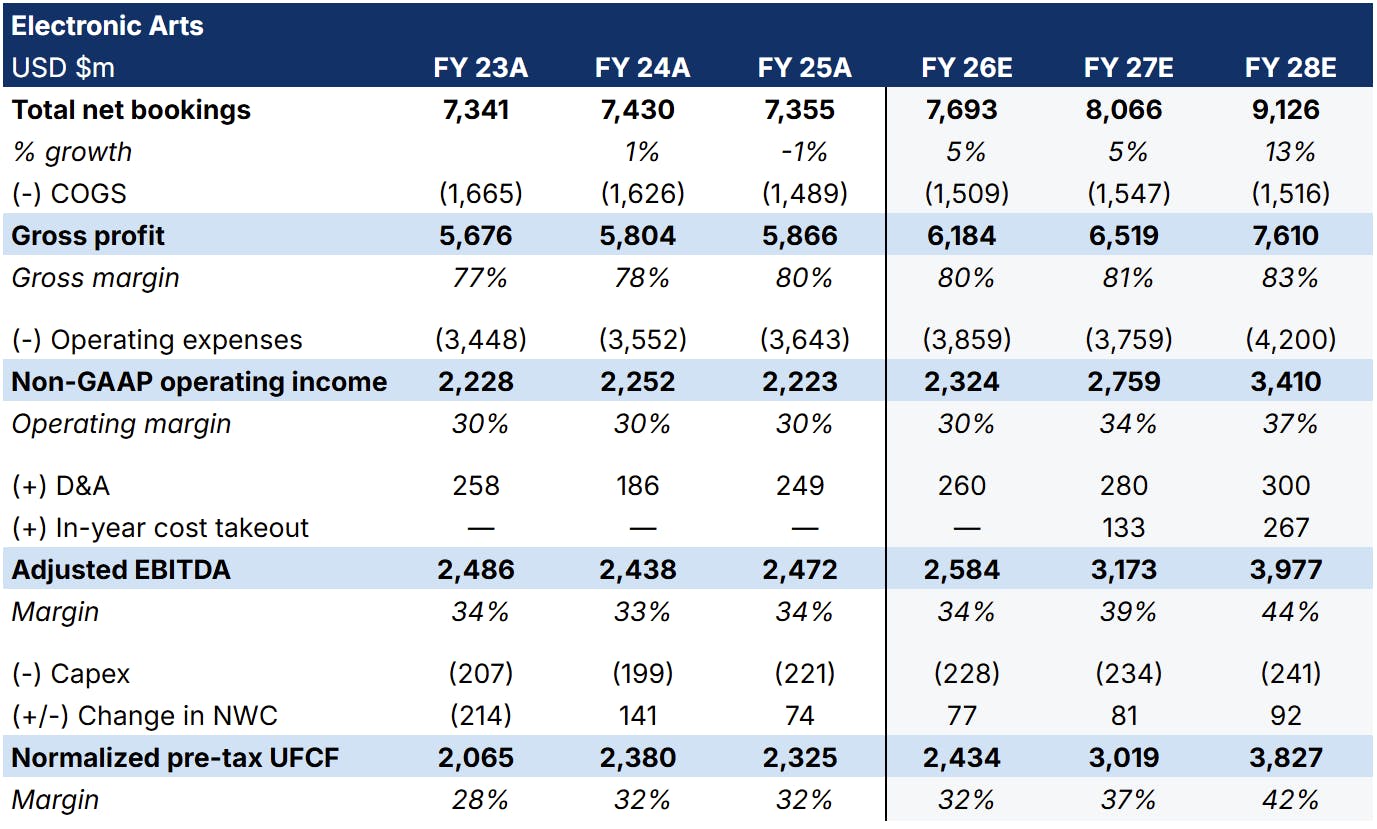
Notably, Silver Lake and its partners are aiming to boost adjusted EBITDA from around $2.5bn this year to $4bn by 2028. By 2032, they want to reach $5.9bn.
They are aiming for a 7% CAGR on total net bookings from 2025 onwards. From today’s level of $7.4bn, that would take them to $9.1bn by 2028 and then $11.9bn by 2032.
Based on gross debt, leverage will be 7.5x out of the gate on a gross basis, based on the company’s adjusted EBITDA. That drops to 5.9x gross when using the its credit EBITDA, which features add-backs including $400m for cost savings and $257m for R&D investments.
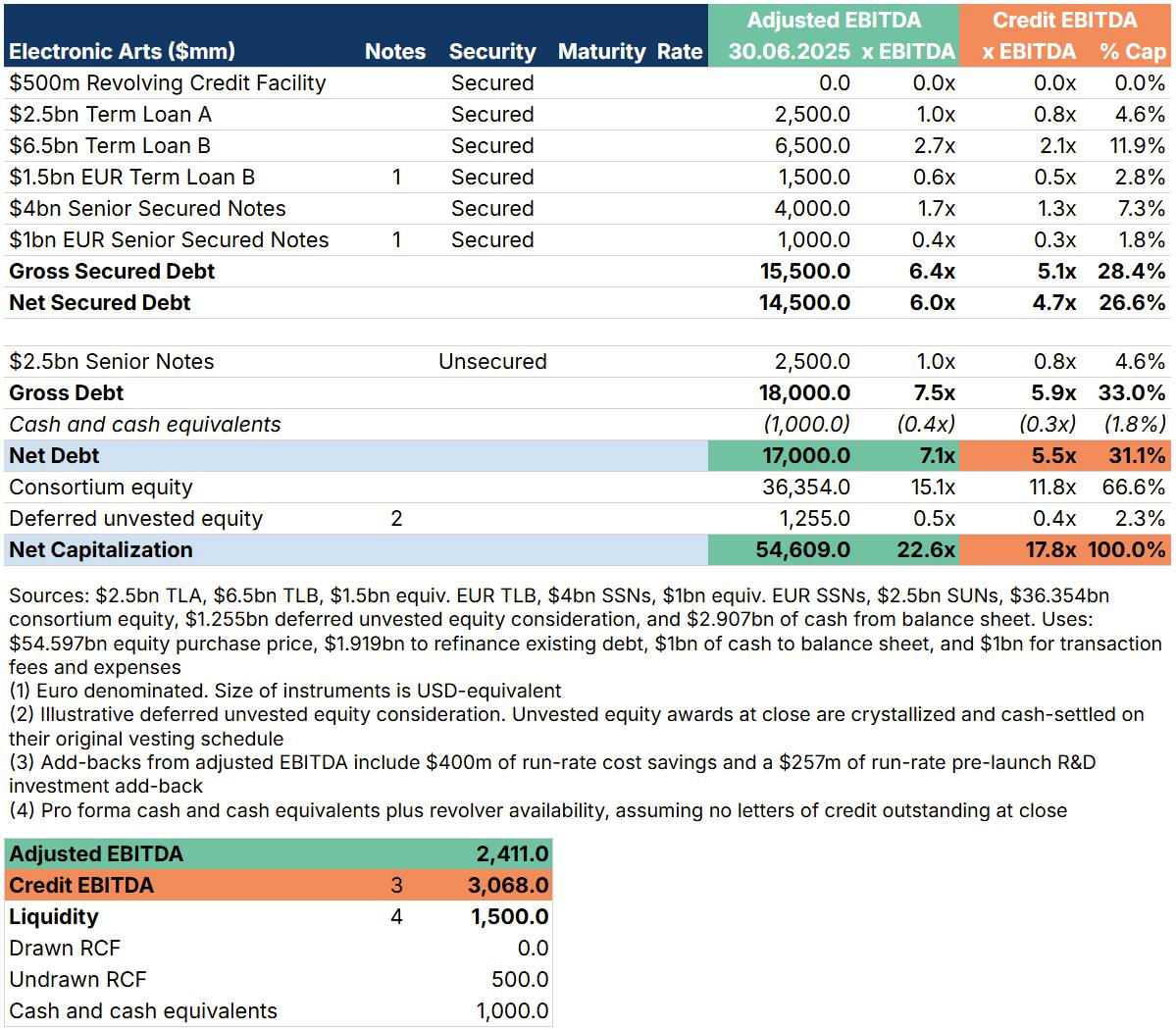
The documents suggest the company wants to move fast on deleveraging, from 5.9x gross at close, down to 4.8x by 2027, 3.7x by 2028, and 2.8x by 2029. Interest coverage is marked at 1.6x for 2027, but projected to grow to 1.9x in 2028, and 2.8x in 2029.
Free cash flow to total debt is forecasted at 18% for 2027, rising to 25% in 2028, and 34% in 2029, according to the documents.
It’s (mostly) in the games
Headquartered in California, EA is behind some of the world’s top-selling video game franchises. It is probably best know for its football (or soccer, depending on where you live) brand, which is now called EA FC but still known to many as Fifa.
This game’s influence is pervasive: here’s a video of some of the Manchester City lineup reacting to their ratings within the game. About half of EA’s net bookings over the last 12 months came from this franchise.
Meanwhile, American football games made up 14%, The Sims accounted for 5%, and Battlefield 1%. In that same period, EA FC brought in $2.5bn of operating income, dwarfing $400m from American Football and $200m from The Sims.
Gamers will be happy to hear that the sponsors’ growth plan includes continued development of some of these EA franchises, as well as reviving its Battlefield title, which the 2021 outing got mixed reviews. Battlefield 6 since its release earlier this month has had a better reception so far.
They may be less pleased to hear about plans for in-game advertising, and possibly skeptical of the idea that AI may be used to help develop new games. But some mention of AI is pretty much obligatory when setting strategy these days, especially if you’re a tech company.
Here’s the full list of the five growth points:
- Further developing the sports titles — This collection includes EA FC, as well as Madden NFL, EA Sports College Football, EA Sports UFC, and NBA Live
- Revitalize Battlefield — This franchise has received recent R&D investment, and the sponsors are keen on increasing EA’s share of the $10bn-plus shooter game market
- In-game advertising — This one is pretty self-explanatory
- Leverage AI — Specifically, use AI to speed up game development, explore new gameplay formats, and enhance personalization
- Business optimization — Targeting $400m of cost savings “across all buckets of opex” with “70% attributable to R&D”, plus other savings including public company costs
The presentation estimates the total size of the global video game industry at $220bn, citing figures cribbed from Bain and Bloomberg among other data providers.
This is much bigger than the market other less interactive forms of digital media such as video and music, which the presentation estimates at $160bn.
JP Morgan declined to comment. EA and the Silver Lake-led investor consortium did not respond to requests for comment.
Join the 6,000+ professionals getting 9fin's news and analysis delivered straight to their inbox — sign up for The Memo US newsletter.