On 11 August, Air Baltic released a business plan addressing its near-term liquidity needs. It’s set to raise €325m of committed new money, comprising €225m of exit debt and €100m of new equity, alongside a €225m interim bridge expected to be refinanced with the exit facility. Bondholders would receive aggregate take-back debt of up to €125m against the €380m (€340m and €40m tap) notes outstanding.
The Latvian airline managed to secure bondholder approval for a series of resolutions, clearing the way for a subsequent vote on its €225m interim financing set out in its latest business plan. On Monday, 24 August, Air Baltic executed the second supplemental trust deed, making the bondholder-approved amendments to the existing notes effective.
Recently, The Latvian Parliament passed a law authorising the government to extend the deadline on its €30m loan, convert the loan and up to €50m of the state’s bonds into equity, and participate in the airline's interim financing by buying up to €30m newly issued bonds on identical terms to private investors.
Alongside the restructuring, Air Baltic has presented forecasts through FY 31 which assume a significant improvement in profitability despite a much smaller fleet and limited capacity growth. In this report we will examine the new capital structure, and explore management’s business plan.
We present our stress case, under which the airline runs out of liquidity by 2030. We then explore recoveries and potential equity value at exit. Our base case provides comfortable recovery and equity value, while the stress case results in only a 82% recovery on the reinstated notes and no equity value.
The new capital structure
Under the proposed transaction, Air Baltic will first raise €225m of interim financing to address its immediate liquidity requirements. This will subsequently be refinanced through a permanent exit financing package comprising €225m of new debt and €100m of new equity.
The €225m interim financing is expected to be secured on a first-out basis by the collateral package currently securing the 2029 notes. The company estimates the going-concern value of this collateral at around €506m.
The restructuring will also partially equitise the existing 2029 SSNs. Participating and non-participating bondholders are assumed to receive aggregate take-back debt of up to €125m, compared with €380m of 2029 notes currently outstanding. This implies a €255m, or around 67%, reduction in principal.
The company also plans to equitise or cut down a portion of its financial, lease and other liabilities, although it has not disclosed the exact amount or which individual liabilities will be affected.
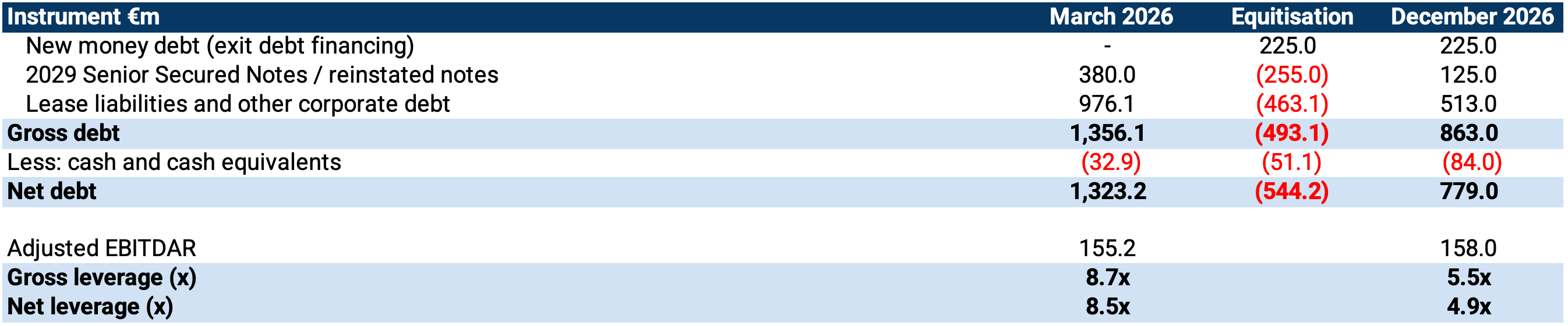
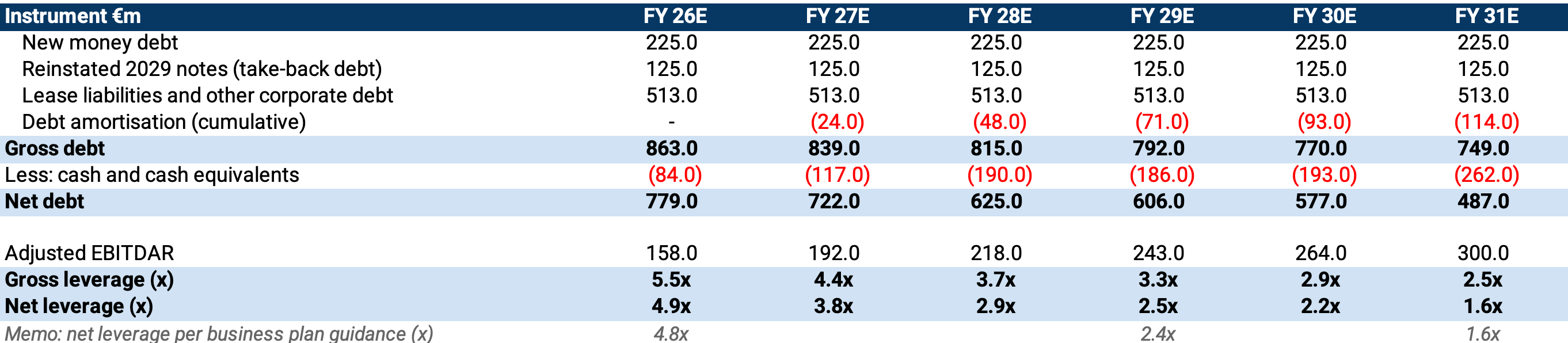
Based on the company’s guidance and our model, lease liabilities and other corporate debt fall to around €513m following the restructuring. Together with the €225m exit debt and up to €125m of take-back notes, this results in pro forma gross debt of around €863m.
This compares with €1.36bn of gross debt at the end of Q1 26, implying a reduction of almost €500m before taking into account the increase in cash. With €84m of unrestricted cash forecast at FY 26 year end, our model implies net debt of around €779m, or 4.9x FY 26E EBITDAR. This is broadly consistent with management’s guidance of around 4.8x net leverage following the recapitalisation.
As of Q1 26, Air Baltic had €883.8m of lease liabilities and only €92.3m of other debt outstanding. After the transaction, the combined amount is expected to decrease by €463.1m to €513m.
Management case
The main shift in the business plan is that Air Baltic is effectively abandoning its previous growth strategy. The company previously planned to operate around 100 aircraft by 2031. It now expects an all-Airbus A220 fleet of around 40 aircraft, with Riga remaining the core hub and secondary bases used for selected point-to-point services. The company will prioritise frequency and depth in existing markets rather than broad network expansion.
ACMI (Aircraft, Crew, Maintenance, and Insurance) flying will also become more important, with management expecting year-round deployment with ACMI customers to reduce the fixed-cost burden during the weaker winter season.
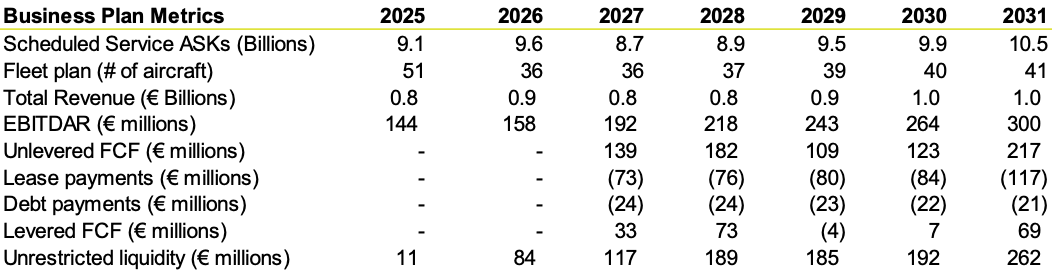
Air Baltic has provided forecasts through FY 31 as part of the new business plan.
Source: Company Announcement
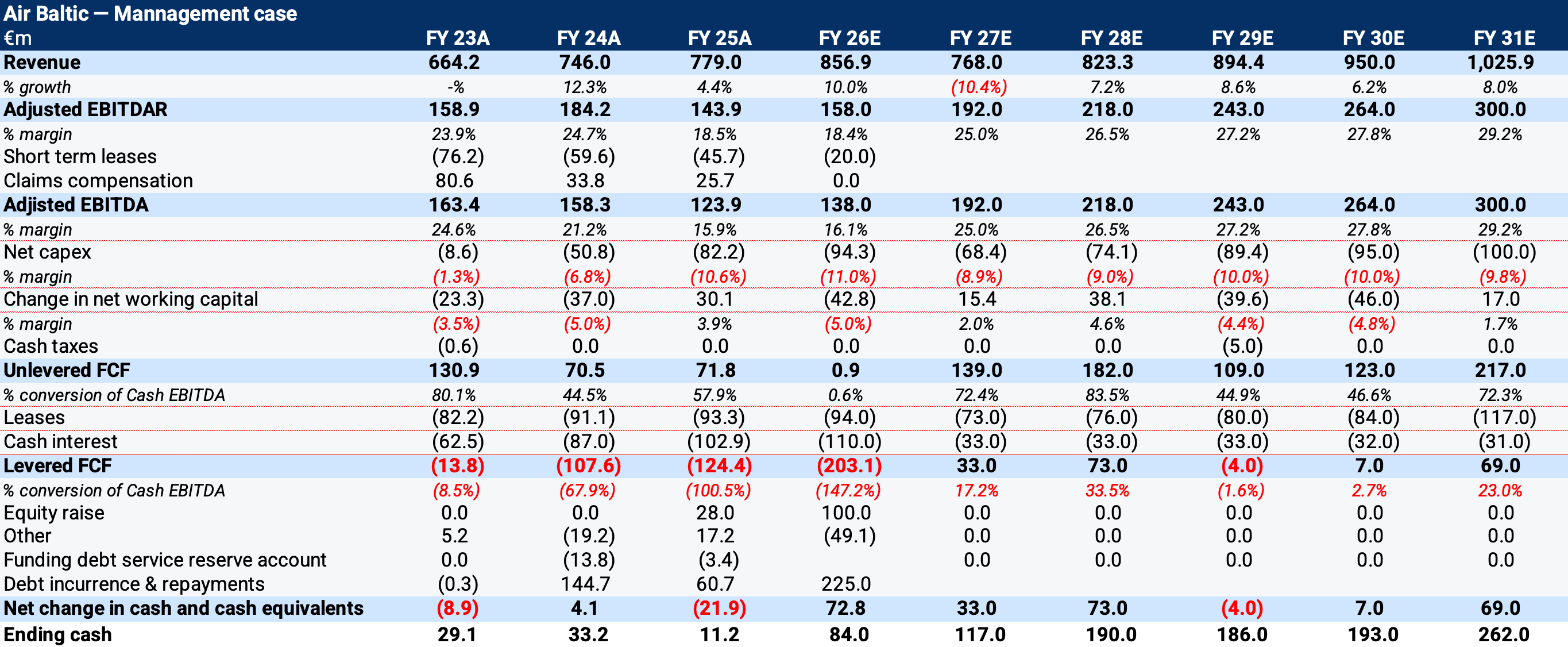
We have consolidated these into a cash flow model to better understand the underlying assumptions and trajectory of the business. However, we note that this reflects our interpretation of management’s guidance rather than a company-provided model. As management has not provided estimates for capex or net working capital, we have used historical levels and the gap between EBITDAR and unlevered FCF to make an educated estimate of what these could be.
Capacity: Scheduled service ASKs are expected to fall from 9.6bn in FY 26 to 8.7bn in FY 27 as the fleet is reduced, before gradually recovering to 10.5bn by FY 31.
Revenue: Management expects revenue of around €0.8bn in FY 27, €0.9bn in FY 29 and €1bn in FY 31.
Our model implies that revenue growth is therefore not primarily driven by capacity. Based on management’s ASK forecasts, implied RASK falls slightly in FY 27 before increasing in subsequent years. This means that part of the revenue recovery depends on better pricing and mix rather than simply flying more capacity.
EBITDAR: EBITDAR is expected to increase from €158m in FY 26 to €192m in FY 27, €243m in FY 29 and €300m in FY 31. This represents a margin increase from around 18% in FY 26 to 25% in FY 27 and around 29% by FY 31.
The improvement is supported by €45m of targeted annual operating cost reductions from fleet, network and operational initiatives.
Short term leases: The Pratt & Whitney engine disruptions have resulted in high short term lease costs in recent years, as Air Baltic relied heavily on wet leases to compensate for grounded aircraft. The situation has resolved as of Q1 26, with no aircraft-on-ground disruptions related to engine inspections.
Hence, from FY 27 onwards, we assume no short-term lease costs or claims compensation, effectively making management’s presented EBITDAR equivalent to EBITDA. For FY 26, we still assume some short-term lease cash outflows, as the presented year-end liquidity was too low to reconcile with the expected FY 26 EBITDAR without them.
Capex: Management has not separately provided capex guidance in the announcement. We therefore estimate capex based on historical spending and the company’s unlevered FCF guidance. We expect lower capex in 2027 and 2028 due to the smaller fleet and lower ASKs, followed by a gradual increase in subsequent years as ASKs and the fleet grow. Our model assumes net capex of around €68m-€100m per year from FY 26 to FY 31. Some slight fluctuations in the capex margin are also assumed to reconcile with management’s unlevered FCF guidance.
Net working capital: Management has not provided explicit guidance for net working capital. We use it as a balancing line to get to the unlevered FCF guidance which produces some volatility throughout the forecast horizon.
Unlevered FCF: Management expects unlevered FCF of €139m in FY 27, increasing to €182m in FY 28 before falling to €109m in FY 29. It subsequently recovers to €123m in FY 30 and €217m in FY 31.
Leases: Management forecasts €73m in FY 27, rising to €80m in FY 29 and €117m in FY 31 which is lower than historical levels because of the early exit from some leases.
Debt payments: The gap between unlevered FCF less lease payments and levered FCF is around €31m-€33m. This is around €9m-€10m higher than the debt payment figures presented by management (between €21m-€24m). By reconciling this with management’s leverage guidance, we concluded that the forecast debt payments are actually debt amortisations, which we assume will be used to amortise the new money debt. We therefore assume the additional €9m-€10m of outflows could be interest payments.
Levered FCF: After lease and debt payments, levered FCF is expected to be €33m in FY 27, €73m in FY 28, negative €4m in FY 29, €7m in FY 30 and €69m in FY 31.
Other: We have assumed €49m of other items to fully reconcile FY 26 year -end expected liquidity of €84m. We assume part of it will be transaction costs and the other part could be non-recurring costs related to increased jet fuel prices because of the Iran war.
Liquidity: Unrestricted liquidity is expected to increase from €84m at the end of FY 26 to €117m in FY 27 and around €262m by FY 31.
Leverage: Management expects net leverage to fall from around 4.8x after the recapitalisation to 2.4x in FY 29 and 1.6x by FY 31.
9fin case
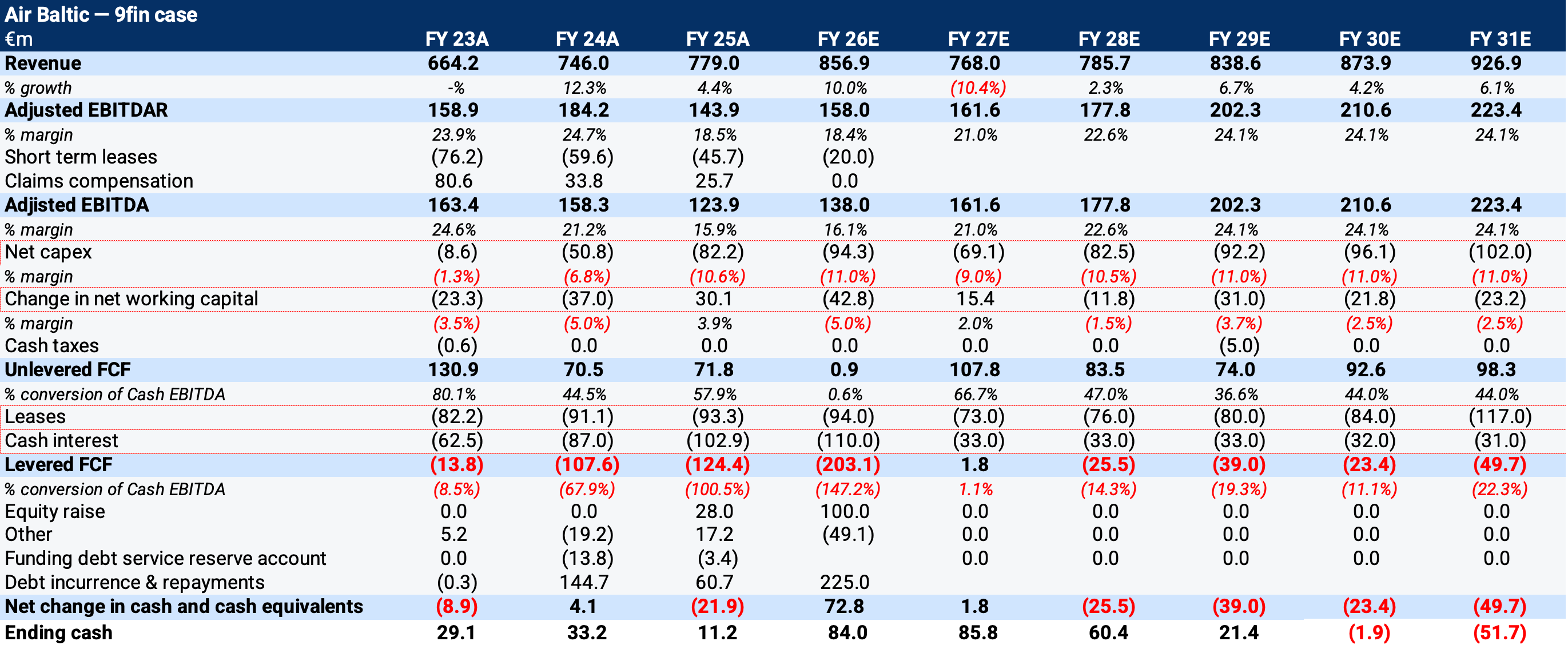
Here, we present our more conservative assumptions to stress test Air Baltic’s liquidity.
Revenue: We maintain FY 26 and 27 forecasts as they are in the business plan. However, in the following years, we maintain management’s guidance for ASK but we assume the RASK will remain constant from FY 27 onwards
EBITDAR: We assume €20m of the cost savings will be achieved in FY 27 and the remaining €25m of cost savings will be achieved in FY 28 and FY 29, increasing the margin to 24.1% by FY 29 and remaining around that level for the following years. However, it is still well below the management forecast of 27% in FY29 and 30% in FY 31.
Capex: We have assumed slightly higher capex margin than the one we assumed in the management case.
Net working capital: To further stress test the liquidity we have assumed net working capital outflows to support revenue growth.
Liquidity: Under the stress case Air Baltic would generate substantially negative levered FCF and would run out of liquidity by FY 30.
Recovery and equity value
The €225m interim financing is expected to be secured on a first-out basis by the collateral package currently securing the 2029 notes. The company estimates the going-concern value of this collateral at around €506m. This is well above the €350m combined amount of new money debt and reinstated notes. However, the €506m valuation is also based on a going-concern scenario. The company explicitly warns that recoveries from the collateral would be materially lower in a liquidation.
In our recovery and equity value analysis we assume an exit at the end of FY 29 with any remaining value exceeding the lease liabilities and outstanding debt flowing to equity and discounted back to 31 December 2026 at a 15% annual discount rate.
The restructuring materially reduces the amount of debt that needs to be supported by the business, but the company has not disclosed the allocation of equity between the providers of the €100m equity injection, existing shareholders, bondholders and holders of other equitised liabilities.
This makes it difficult to calculate the exact recovery for existing noteholders from the information currently available. The €125m take-back debt represents around 33% of the original principal before considering any equity received as part of the equitisation.
We have therefore looked at the value of the post-restructuring capital structure rather than attempting to assign the equity between individual creditor groups.

Public peers trade between an EV/EBITDA multiple of 2.7x and 5.4x with an average of 3.7x. For our base case we will use management’s case FY 29 EBITDAR whereas for the stress case we will use our stress case FY 29 EBITDAR and ending cash.
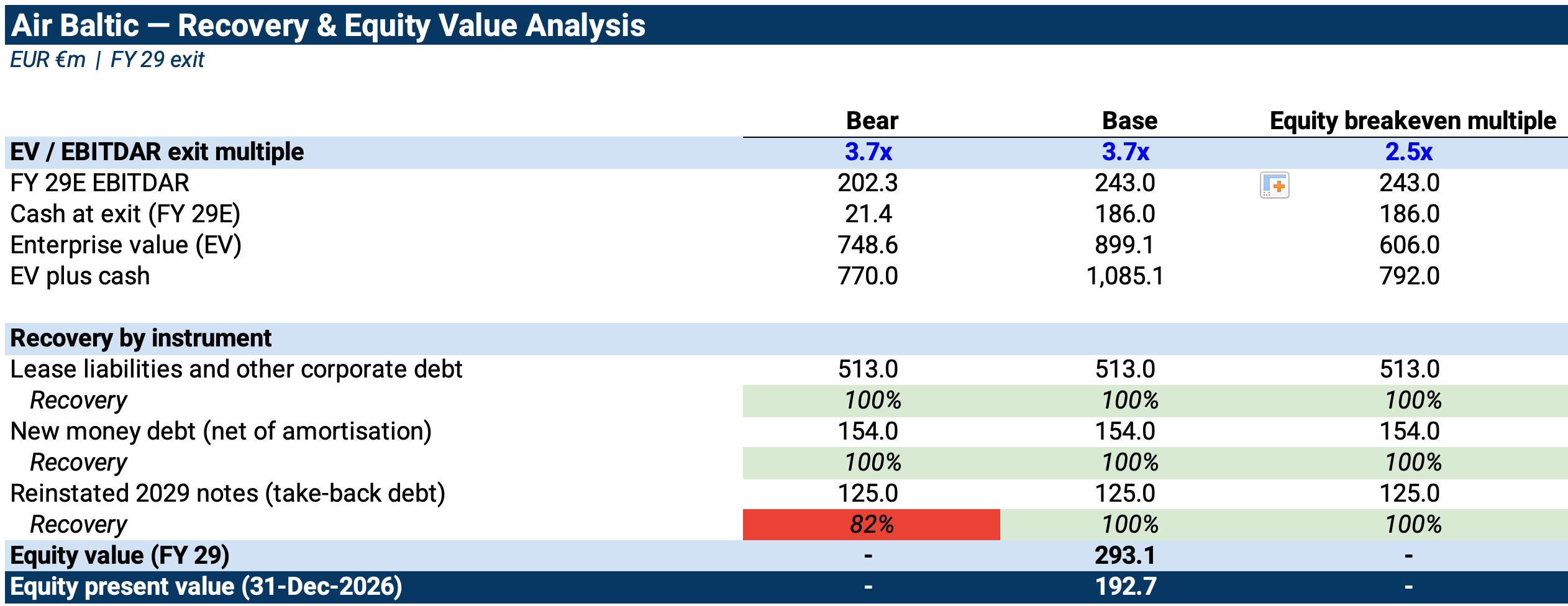
The base case gives us 100% recovery on all debt instruments and an equity present value of around €193m. The bear case gives us 100% recovery of the new money debt (net of amortisation) and 82% recovery of the reinstated 2029 notes with no equity value left. The base case equity breakeven multiple is 2.5x.