
Don’t miss out on news you won’t find anywhere else — get The Memo US and The Memo Europe in your inbox every two weeks.
Optimum Communications, fka Altice USA, is sending a message to all of the lenders of its newest $2bn credit facility: JP Morgan, as the sole lender, can under no circumstance, enter into a cooperation agreement with… itself?
On 25 November, the company announced that it had secured $2bn in new unsub term loans commitments implemented through an unsub credit agreement. On the same day, the company announced litigation against its existing lenders for forming a cooperation agreement in violation of antitrust law (discussed here).
In its newest unsub credit agreement, Optimum included “anti co-op” language. The kicker, however, is that a look at the credit agreement shows the entire loan was from one lender — JP Morgan Chase Funding.
JPMCF, a subsidiary on the investment banking side of the larger firm, is not part of the broader Altice USA cooperation agreement. It is already one of the banks providing the revolving credit facility which was primed by this new loan with respect to the assets at the unsubs. This in essence was a self-help deal by JPMCF to ensure that no one else did the priming deal to jeopardize the revolver. Most important, it is separate and apart from JP Morgan Asset Management, which is part of the existing co-op (and named in the antitrust lawsuit). Both claim the ultimate parent JP Morgan Chase & Co.
Additionally, the anti co-op language was only included in Optimum’s unsub credit agreement, but not the fourteenth amendment to the previous existing credit agreement, which was announced in the same 8-K. The existing credit agreement was amended in order to allow for the paydown of the restrictive B-6 term loan and to un-restrict the subsidiaries with the assets that are now being primed by the new loan.
Therefore, it does not feel correct to say anti co-op language has “cleared the market” since the loan was not broadly syndicated and only has one listed lender.
All this leads 9fin to conclude that the chances of the new loan’s lenders — again, just JPMCF — signing some other cooperation agreement, or the one that already exists and is being litigated, was already quite low without the anti-coop language. So why include it?
This anti co-op language prevents not just initial lenders, but any future lenders from being co-op members as well. It therefore has the effect of preventing JPMCF from selling the loan in the secondary market to any lenders elsewhere in its capital who have signed on to cooperation agreements — which based on the complaint appears to be nearly all of them.
Still, the inclusion of this language in Optimum’s unsub credit agreement amid its antitrust litigation poses the question of whether cooperation agreements are the type of behavior that is actually “illegal” as the company alleges in its complaint, or whether it is the type of behavior that must be contracted around like any other action among borrowers and lenders.
Presumably, if the cooperation agreements are illegal, there is no need for the company to specify in a contract that lenders will not engage in this type of specific illegal behavior. However, the most likely explanation is the company is hedging its bets — while it hopes its litigation succeeds, it is including this language in the event it doesn’t. This is similar to the many borrowers and sponsors who started drafting broader assignment provisions while the Serta open market litigation played out.
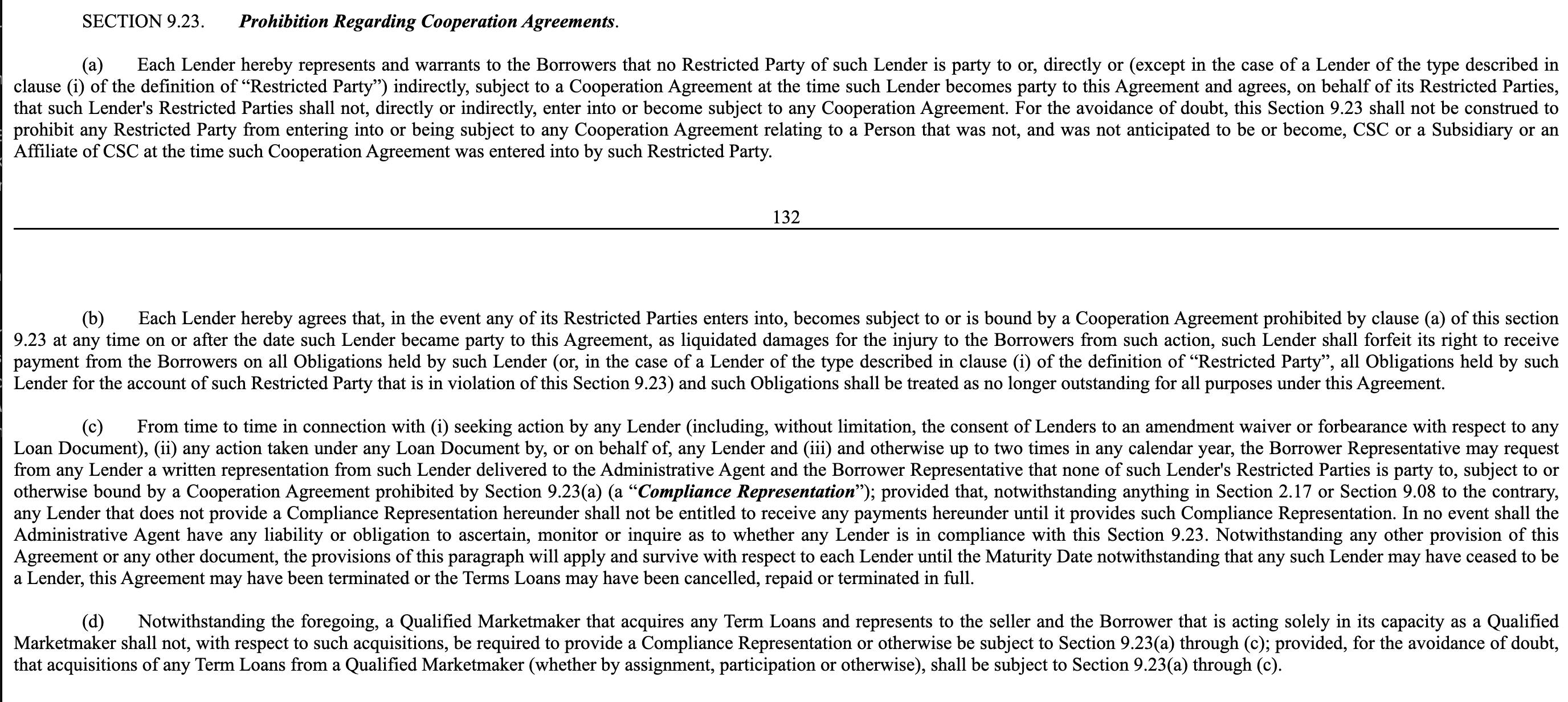
The language is titled as a “Prohibition Regarding Cooperation Agreements” and provides that no restricted party at the time of entering into the agreement, or after, will enter into or is party to a cooperation agreement. If a lender violates this provision, the resulting liquidated damages will be that lender will forfeit its right to receive payment “on all Obligations held by such Lender.”
Finally, the borrower can at certain specified times (detailed below) request written representation from its lenders that they are not bound by a cooperation agreement and are in compliance with these provisions.
Enforcement mechanism
The “Compliance Representation” appears to solve an issue regarding enforcement mechanisms for niche anti co-op technologies. There has been an open question in negotiations of other technologies — namely voting and concentration caps — as to who would be responsible should the clause be breached, 9fin reported.
The compliance representation requires lenders to represent that they are not subject to a cooperation agreement when taking an action, or if asked by the borrower, which can be requested up to twice per year. It also requires that purchasing lenders represent to the seller and borrower that they are not be subject to a co-op at time of acquisition.
Representations at the time of acquisition are how voting and concentration caps are policed — at the signing of the assignment agreements. The compliance representation requests by the borrower appears to be an additional step designed to enhance enforcement.
JPM’s direct lending arm previously rejected anti co-op language
To 9fin’s knowledge, this language has not appeared in any private credit or broadly syndicated credit agreements that have passed the market.
In April, a cooperation agreement blocker was introduced as part of a debt package to support Thoma Bravo’s acquisition of Jeppesen, an aeronautical navigation software company, according to 9fin sources.
Just before closing, Thoma attempted to include an anti co-op clause. The lenders pushed back and the clause eventually failed to clear the market, sources said. Kirkland & Ellis — staunch opposer of co-ops — represented the borrower in both the Optimum and Thoma Bravo financing packages.
The $10.55bn acquisition of Jeppesen from Boeing was supported by a $4bn debt package supplied by an all-star cast of direct lenders, including Apollo, Blackstone, Ares, Blue Owl, KKR and JP Morgan’s direct lending strategy, Bloomberg reported at the time.
Thoma Bravo, Ares, Blackstone, JP Morgan, and KKR declined to comment. The rest did not respond to a request for comment.