
This is an extract of our investment grade credit research. For the full piece, get in touch for a free 30-day trial.
European credit has absorbed a run of shocks over the past year, from tariffs and energy-driven inflation to weak construction and consumer demand, and the strain is showing unevenly.
Strong issuers have refinanced with considerable comfort, while those at the bottom of triple-B have been left with thinner margins for error as funding costs stay elevated.
A rating downgrade from investment grade (IG) to high yield (HY) carries heavy consequences. Because crossover spreads remain a multiple of the main index, investors demand a steep premium for taking on the extra risk.
A fallen angel is an issuer that has been downgraded from IG to HY status, triggered when at least half of the agencies that rate it, typically Moody’s, S&P and Fitch, lower the issuer’s credit rating below the IG threshold. Rising stars move in the opposite direction, achieving or regaining IG status under the same methodology.
The pool for potential fallen angels is Baa3/BBB- issuers, but downgrade risk varies widely, and outlooks, agency thresholds and credit-metric trends show whether the pressure is temporary or lasting.
Option adjusted spreads on double-B euro-denominated debt are around 325 basis-points (bps), as of 16 November, according to the ICE BofA Euro High Yield Index OAS.
Read the ratings methodologies and definitions of Moody’s, S&P and Fitch.
Fallen angel contenders
We have identified 140 corporate issuers with at least one Baa3/BBB- rating. Many of which are recent rising star issuers which carry a much greater likelihood of becoming fallen angel than debutant IG issuers.
The dataset includes 15 issuers that have at least one negative outlook, while 26 have at least one positive outlook. The Materials sector has 5 issuers with negative outlooks, the most of any sector, due to severe cost pressures, strict regulations, and heavy import dependencies.
Our fallen angel candidates include European-domiciled, corporate issuers with syndicated debt outstanding, at least one Baa3/BBB- CFR and a negative outlook by the corresponding agency. We have ranked the list by issuers with the most total debt outstanding.
The fallen angel candidates below excludes issuers where at least half of their ratings are HY. The screener used to create this report can be found on the 9fin platform.
You can also view a complete list of all 140 corporate issuers with at least one BBB-/Baa3 rating on 9fin.
Stellantis (Baa3 S/BBB- N) — €56bn
Stellantis is a global automaker that owns brands including Jeep, Ram, Peugeot, and Fiat.
Ratings sit at the floor of the IG bucket after both S&P and Moody’s cut to Baa3/BBB- on 10 February, following €22.2bn of charges from the EV reset. S&P has a negative outlook, citing a protracted recovery in earnings and cash flow. Moody’s said it could downgrade if profitability stays in the low single digits and adjusted gross leverage stays meaningfully above 3x, or if free cash flow doesn’t turn meaningfully positive. Adjusted operating margin was 0.7% in the third-quarter (Q3), and 2026 guidance is for a single-digit margin.
Industrial free cash flow was -€4bn in Q3 on seasonal working capital (-€4.9bn for nine months, from -€7.3bn a year earlier), which cut industrial net cash from €10bn at end of June to €5.4bn; reflecting a real pressure point for Stellantis. Management reaffirmed guidance for improved cash flow in 2026 and positive cash flow in 2027, relying on a Q4 working-capital reversal and cost savings, with a €6bn run-rate target by 2028.
Liquidity provides a much needed cushion, with €42.7bn of industrial liquidity (26% of revenue, inside its 25%-30% target) against about €2.2bn of notes due in 2027. Of the €56.0bn of debt, €30.1bn is in financial services. The €5bn of hybrids issued in March, which are treated as equity, and the suspended 2026 dividend also support the balance sheet. The risk is Q4 delivery, because a miss would leave the 3x leverage threshold exposed.
Barry Callebaut (Baa3 N/BBB- N) — CHF 4.2bn (~€4.6bn)
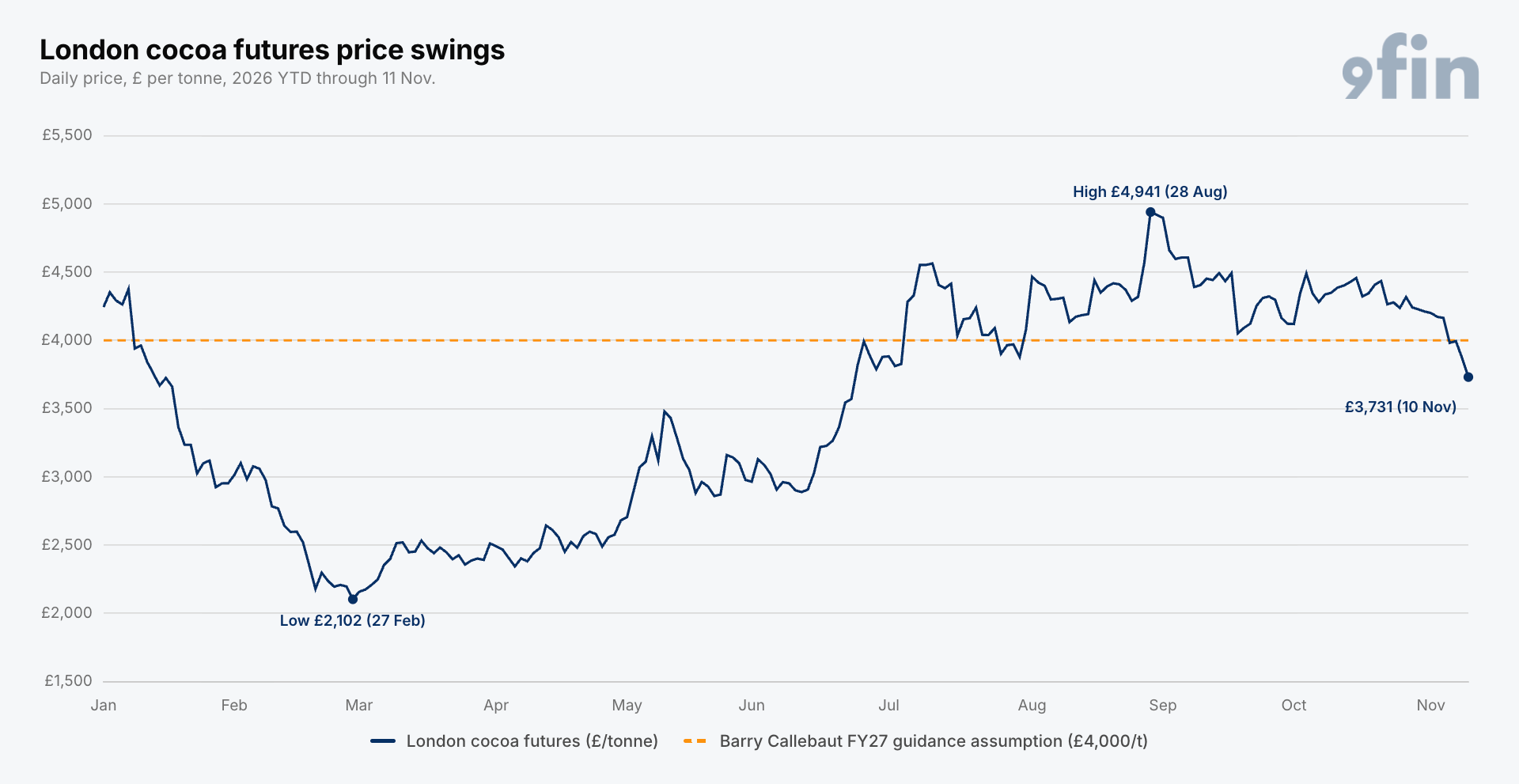
The world’s largest maker of industrial chocolate that supplies products to Nestlé, Hershey and Mondelez has cut leverage from 6.5x to 2.9x in 18 months, but both Moody’s and S&P still have it on negative outlook.
Both agencies have negative outlooks, set in April 2025 when cocoa prices were driving up working capital and debt. Moody’s has said that negative pressure could arise if adjusted leverage stays well above 3.5x beyond fiscal 2026, retained cash flow to net debt falls below 20%, or EBITDA doesn’t grow towards CHF 1bn. Moody’s would consider an upgrade if gross debt/EBITDA falls towards 2.5x.
Free cash flow of CHF 2.0bn in FY 26 cut net debt 43% to CHF 2.5bn and net debt/EBITDA from 4.5x to 2.9x, from a 6.5x peak in February 2025. Lower cocoa prices released working capital, and the company repaid about CHF 1.5bn of debt, including an €849m bond buyback in June. Adjusted for cocoa bean inventories, leverage is 1.5x.
This is an extract of our investment grade credit research. For the full piece, and to see what else we cover on IG, get in touch for a free 30-day trial.