Join the 6,000+ professionals getting market news and analysis delivered straight to their inbox — sign up for The Memo US newsletter.
Litigation brought by funds of Republic Capital against venture capital fund Romulus Capital and one of its co-founders Neil Chheda alleges, among other things, that Chheda was effectively short the privately held shares of EquipmentShare — a company where he served as a member of the board and his fund had invested in.
With lead plaintiff Republic Maximal (a Republic fund), the complaint in the United States District Court for the District of Massachusetts which was originally filed in March of 2022, had a big update on 31 October 2025.
The update accuses Romulus and Chheda of fraud stemming from transactions involving the purchase and sale of LP Interests in a special purpose vehicle that holds shares of Series A-1 preferred stock in EquipmentShare.
The Republic litigation and its request for sanctions include allegations that Neil Chheda defrauded plaintiffs through misrepresentations and false valuations to plaintiffs about their shares, which places Chheda in a short position against EquipmentShare.
The complaint tells a colorful story of “serial fraudsters”, forged signatures — including of one person who is deceased, missing and destroyed documents, an intern who played a big role at the company but turned out not to exist, and false valuations.
Timing of litigation developments coincides with impending IPO
Chheda and Romulus, for their part, recently sued EquipmentShare, a construction technology company that has grown rapidly, raising more than $2bn in high yield debt, and that has been gearing up for an IPO.
Chheda alleges fraudulent practices, self interested dealing and attempts to oust Chheda from the board in effort to prevent him “from bringing to light significant fraud.” In this complaint, as part of the requested relief, Chheda sought reinstatement to the board and/or permission for Romulus to designate a new board member.
Typically, an IPO represents a value-maximizing liquidity event for all shareholders involved. Accordingly, companies and investors — even more so than usual — look to prevent any negative press that could impede the success of an upcoming IPO.
This is why the timing of EquipmentShare’s board fight and Neil Chheda’s litigation against the company strike so many as oddly timed.
Breaking down the short and potential exposure
The facts as recounted in the Republic complaint assert that Neil Chheda orchestrated the following transaction:
- Original LP interests were sold for $3.7m to entities controlled by Vasant Chheda (Neil's father);
- Days or weeks later, these same interests were sold to plaintiffs for $44m;
- Plaintiffs, based on statements from Chheda, believed they were paying based on a $102m valuation, when the actual valuation was much higher.
The brief asserts that Neil Chheda effectively captured the spread between $3.7m and $44m (roughly $40m). However, according to the filings, the plaintiffs now own LP interests that Chheda represented as worth far more than their actual value.
In the event of an IPO the actual valuation, along with all investors holdings would be definitively quantified. If EquipmentShare's true valuation is revealed to be closer to the original basis, the plaintiffs claims would be substantiated and Chheda could face significant liability — potentially having to return the inflated proceeds. Additionally, if Chheda was planning on delivering the extra shares that the plaintiffs believe they are owed, then the higher the valuation, the more difficult it will be.
Republic Maximal litigation origin story
On 22 March, 2022, Republic Maximal and a number of LPs filed a complaint against Romulus and Neil Chheda and a number of related funds in the US District Court, District of Massachusetts. The complaint sought damages related to investments in certain limited partnership funds that were created to invest in shares of preferred stock of EquipmentShare. The complaint alleged the following:
- Romulus and Chheda, using their position as investment advisor and general partner, fraudulently induced the plaintiffs to purchase limited partnership interests at a substantially inflated price;
- Romulus and Chheda misrepresented the valuation of EquipmentShare and failed to disclose that the Transferors through which they purchased their LP interests were not the initial purchasers — and instead acquired the interest through “undisclosed intervening transactions that were based on a considerably higher valuation of EquipmentShare;”
- The defendants misled Republic because the transferors were owned or controlled by Chheda’s family members and Chheda was actually an interested party which he failed to disclose;
- As a result plaintiffs’ interests in these funds is worth “at least $60 million less than what Plaintiffs were led to believe they were purchasing when they entered into the transactions”.
The complaint walks through multiple transactions where the plaintiffs were misled, including:
- The Athena transaction (September 2019) — Here Romulus and Chheda represented the plaintiffs would receive an LP Interest representing 15.08% of the Series A Fund but they received only a 2.51% stake instead. Additionally, the purchase price paid was represented as a 10.2x multiple of the Series A Valuation but was actually an approximately 61x multiple of the Series A Valuation;
- First SNC Transaction (October 2019) — Similarly, instead of acquiring an LP Interest representing 16.96% of the Series A Fund’s total LP Interests, as was represented, the interest plaintiffs received represented only 2.51% of the fund’s total LP Interests, and the purchase price reflected an approximately 91x multiple of the Series A Valuation rather than the represented 10.2x multiple.
There were three additional transactions that all had a similar story. The complaint notes that in the transfer agreements, Transferors signed representations and warranties that stated that Romulus and Chheda were not acting as an “an advisor, finder, agent, broker, or dealer” on the transferors behalf, would not receive any fee or compensation, and their actions were solely for the account of the plaintiffs.
In January 2022, plaintiffs undertook an audit of their investments. At this time they learned that their LP interests and corresponding indirect ownership in EquipmentShare, were significantly smaller than Romulus and Chheda represented. After hiring an accountant to better understand the discrepancy, plaintiffs also learned that contrary to Romulus and Chheda’s representations, the purchase price paid by the transferors for their respective LP interests was not based on the Series A Valuation, but a significant markup. Plaintiffs further discovered that Vasant Chheda, Neil Chheda’s father was the founder and CEO of multiple of the transferors.
After learning all of this and discovering monitoring fees that plaintiffs believe were improperly charged, the plaintiffs sued for among other things: breach of contract, contractual fraud, fraudulent inducement, unjust enrichment, various securities violations, civil conspiracy and breach of fiduciary duty.
Romulus and Chheda’s reply
In Romulus and Chheda’s brief in support of their motion to dismiss, the defendants argue that the plaintiffs lack standing to bring these claims due to lack of parties diversity and the motion should therefore be dismissed.
As it relates to the facts, the defendants assert that the plaintiffs “do not (because they cannot) allege that (i) they did not receive the LP Interests as described in each of the Transfer Agreements; or (ii) they paid any price other than the set price offered to them and accurately reflected in each of the Transfer Agreements.” Accordingly the defendants contend that the plaintiffs received exactly what was agreed to under the contract and their purported misunderstanding was based on “extracontractual statements” made prior to the agreement.
Current state of the litigation
Although some of the claims were dismissed on technical grounds, others were allowed to proceed and required discovery. As a result of Vasant Chheda failing to appear for deposition on multiple occasions, the presiding judge ordered Chheda to pay $50,599.05 in attorney’s fees. Although Chheda requested a motion for consideration regarding these fees, the Judge denied the motion and ordered that Chheda pay the requested fees to Republic. Ultimately, however, the plaintiffs were able to take the depositions of both Neil and Vasant.
After those depositions, on 31 October, 2025 — which happened to coincide with EquipmentShare’s opposition to Romulus and Chheda’s motion for temporary injunction — Republic Maximal filed a brief supporting its motion for sanctions for fraud on the court. The fraud, alleged against both Neil and his father, stemmed from the same five actions detailed in the complaint described above. However, the facts alleged in the motion which were discovered through the depositions take a significantly deeper dive into what, if true, would be an astounding level of fraud.
Forged signatures
According to the plaintiffs’ brief the five transactions required 21 transfer agreements and for three of the transferors, Vasant was the sole owner, officer, and director. However, since the Chheda’s did not want this disclosed, four individuals were designated as “signatories”: (i) Vasant’s sister-in-law, Pushpa Shah; (ii) Vasant’s brother-in-law, Dhiraj Shah aka Dhiraj Dedhia; (iii) Vasant’s deceased brother-in-law, Hitendra Dedhia — yes you are reading that correctly, one of the signors is in fact deceased; and (iv) Dhaval Lalan, a friend of Vasant’s deceased mother.
Even though three out of four “signors” are still living, the plaintiffs allege — and corroborate this with documents produced by defendants, deposition testimony from Neil and Vasant, and the evaluation of an expert forensic document examiner —that none of them actually signed a single transfer agreement, rather Neil and Vasant forged the signatures. The evidence revealed in the depositions includes the fact that both Neil and Vasant are “unable to locate” any documents showing the transmission of the Transfer Agreements to or from any of the four signors.
The intern who never existed
Who is Sarah Williams?
The plaintiffs brief includes a number of emails from Sarah Williams, while also revealing that this “purported ‘former, unpaid intern’ at Romulus who sent emails containing four of the five key extra-contractual fraudulent representations“ did not in fact exist.
Strangely, the brief alleges that Neil Chheda set up the email “SWilliams@romuluscap.com” and then would pretend to be Sarah Williams, looping her into conversations, asking her questions, and the fake Sarah Williams would then reply cc’ing Neil. The Sarah Williams ruse made it into Chheda and Romulus’s court pleadings — the plaintiffs allege that the defendants “represented to this Court and Plaintiffs twenty-three separate times that Sarah Williams was ‘a former unpaid intern at Romulus,’ and sent the key emails Plaintiffs describe in their complaint.”
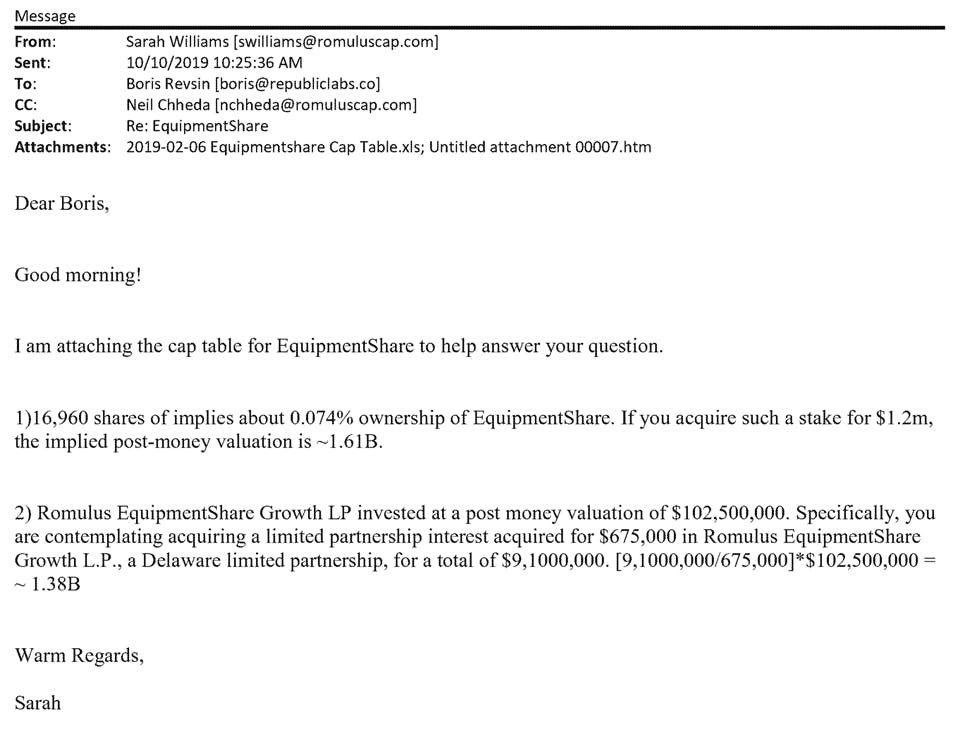
Case 1:22-cv-10429-MLW dkt # 200
When plaintiffs tried to contact Sarah for litigation purposes, counsel for Romulus claimed that “Romulus did not directly engage Ms. Williams as an ‘unpaid intern,’ but instead procured her services through a ‘placement agency’” and therefore had no contact information for her. When plaintiffs asked for the placement agency information so they could subpoena the placement agency, Romulus then responded that the email address was used by unspecified “unpaid interns and/or offshore service providers,” not an individual, even thought they had previously said otherwise. Full explanation below:
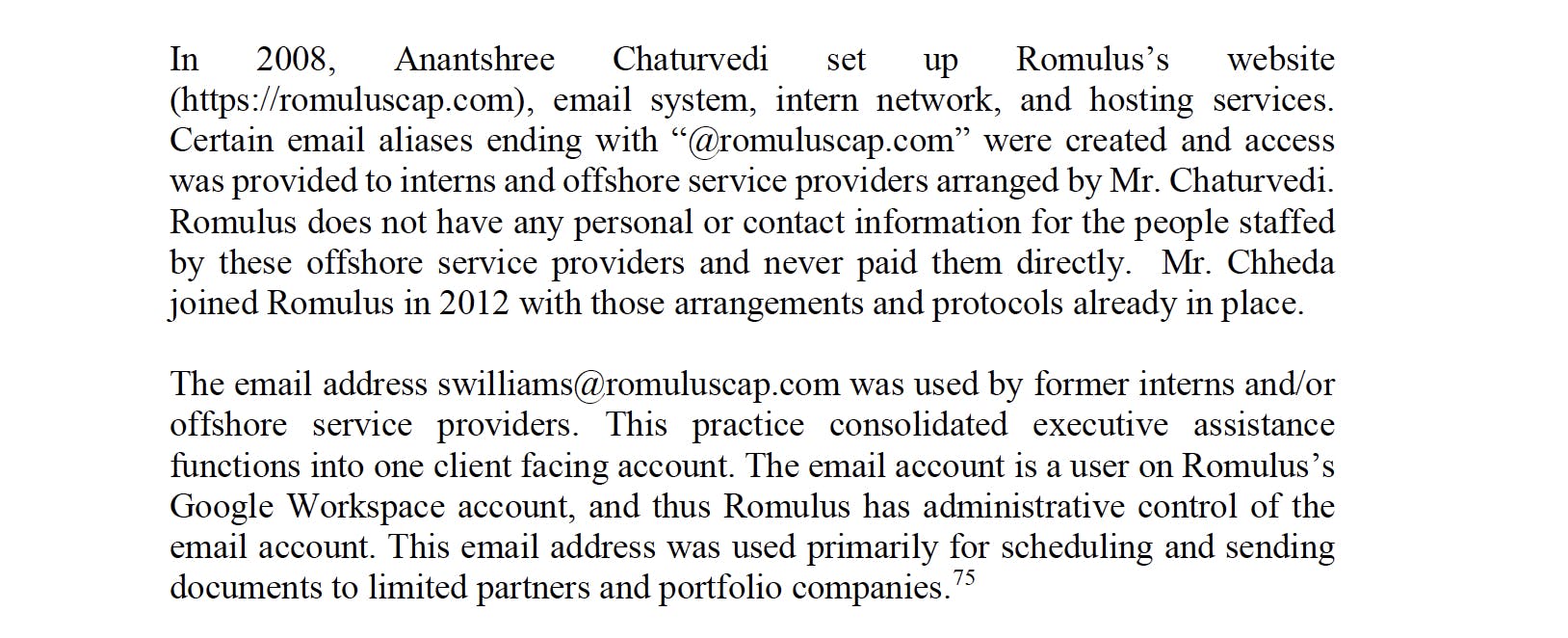
Case 1:22-cv-10429-MLW dkt # 200
Because the sudden change in story — which played out over the course of a year — plaintiffs grew suspicious about the true origins of Sarah Williams and decided to reach out to original Romulus founding partner Krishna Gupta through his counsel, to see if he had an explanation. His explanation which was confirmed a second time through his deposition was shocking:

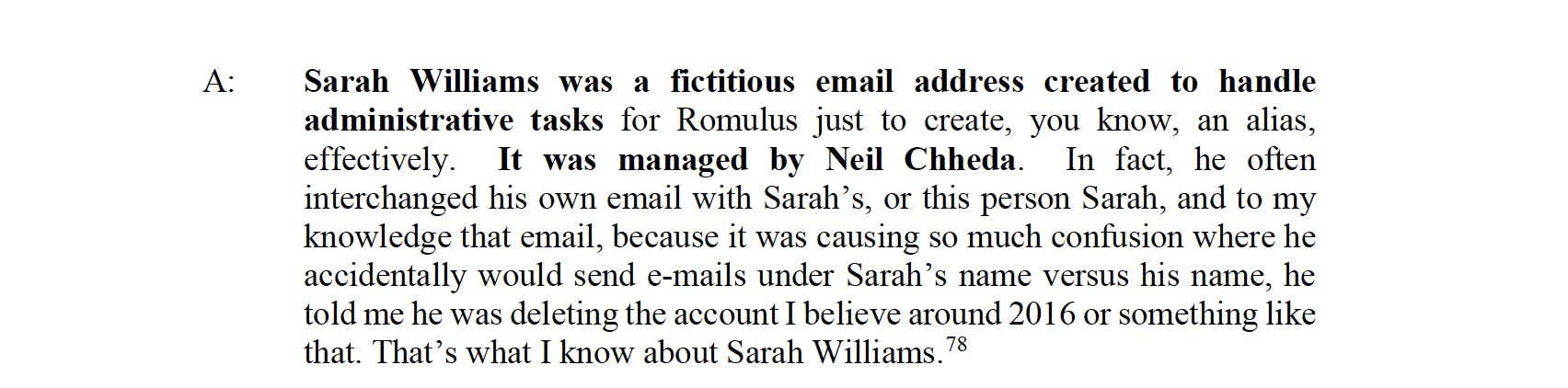
Case 1:22-cv-10429-MLW dkt # 200
Ultimately, in his deposition on 29 September 2025, Neil Chheda “begrudgingly admitted… “that he does not know anyone named Sarah Williams, that he does not know anyone else who used the SWiliiams@romuluscap.com email address, and that he ‘may have’ sent the emails signed with her name (often with the email sign-off, ‘Warm Regards, Sarah’).”
What’s next
As 9fin previously reported, Romulus and Neil Chheda’s attempt to restore Chheda to the board of EquipmentShare has failed. The judge presiding over the case denied a temporary injunction. Although Romulus and Chheda have the right to appeal, it likely would not be sorted out prior to a potential IPO.
The Republic Maximal litigation is still ongoing. Chheda and Romulus will have a chance to respond to the plaintiffs’ brief requesting sanctions for fraud.
The full docket can be found here.
Chheda and representatives for EquipmentShare, Republic Maximal, Chheda, and Romulus did not respond to requests for comment.