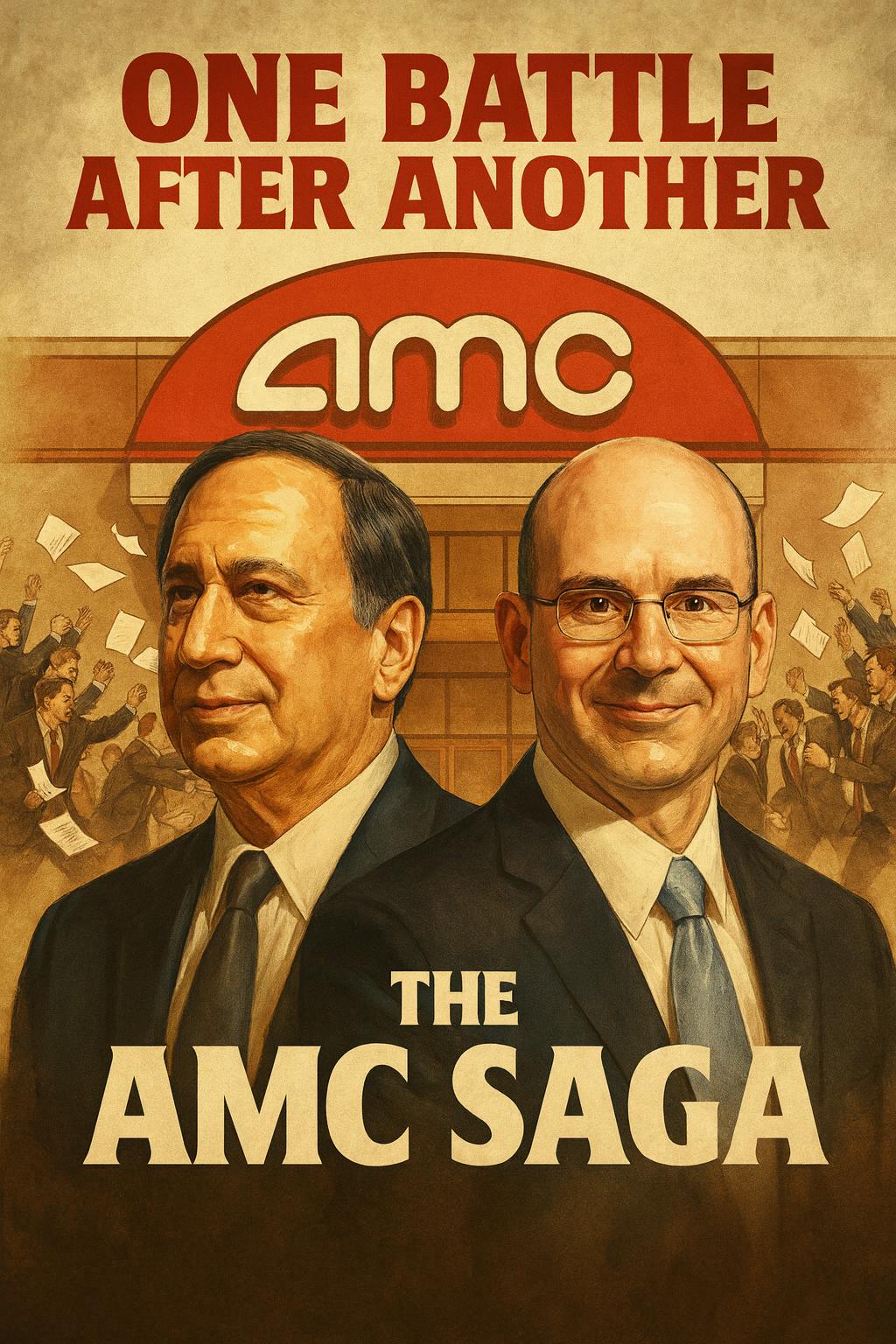
One Battle After Another — The AMC Saga
- Max Frumes
- +Kartikeya Dar
- + 2 more
Doug Ormond stood overlooking Atlantic Beach, a seaside haven on the outskirts of New York City, just beyond Far Rockaway. In its heyday, the town was once home to dynasties like the Vanderbilts and the Kennedys — but this was 2022, and Ormond was talking to a restructuring specialist.
He was on the phone with Barak Klein, of the investment bank Moelis & Co, and they were discussing AMC Entertainment.
AMC was Klein’s client, and he was trying to strike a deal with its creditors, which included Ormond’s employer Discovery Capital. A few investors had been buying up pieces of $1.46bn second lien bond that AMC had issued back in 2020, and Klein thought they might hold the keys to the cinema operator’s salvation.
“There’s another firm that holds some second lien bonds,” Klein told Ormond. “You guys should talk.”
Klein was referring to Marathon Asset Management, a debt-focused hedge fund that managed about $22bn and frequently invested in distressed companies. He knew a guy there called Randy Raisman, a pugnacious investor who had cut his teeth at Credit Suisse First Boston and would soon become Marathon’s co-head of opportunistic credit.
Ormond followed Klein’s advice and called Raisman. The two men agreed they could acheive something by banding together with other second lien holders, and began to form a group.
The Usual Suspects
A Long Island native, Ormond double majored in history and math at the selective New England liberal arts college Holy Cross, one of the ‘Hidden Ivies’. It was a fitting environment for the unassuming Ormond, who liked to keep a low profile while competing at the highest level. He’d soon get the chance to do just that at another elite US institution: JP Morgan.
He did two separate stints at the investment bank before eventually landing at Discovery in 2012. Over the years, almost always from behind the scenes, he cultivated a reputation for his creative tactics in distressed debt investing. He pursued creative strategies that no one else thought of or didn’t have the guts to attempt: a trade in Peabody Energy’s 2016 bankruptcy that returned multiples; complex short plays using CDS to capitalize on the inevitable restructurings of Brazilian telecom firm Oi and Portugal Telecom; battling with Apollo Global Management in a litigation play for bondholders primed in Brightspeed‘s acquisition of Lumen Technologies assets; and leading the formation of arguably the most lucrative equity committee in Chapter 11 history during the Hertz bankruptcy.
Back in the summer of 2022, Ormond was searching for a distressed play in a publicly listed US company that could bounce back from the brink and produce outsized returns. He had hoped Carvana might be a candidate, but it wasn’t really working out (eventually, the company struck a deal with its creditors without surrendering any equity).
AMC looked more promising. This was partly because the company’s second lien notes — the only remaining secured bonds from a series of increasingly desperate debt issuances during the depths of the Covid-19 pandemic — contained a unique covenant against the creation or capitalization of unrestricted subsidiaries:
There was no such covenant in AMC’s term loans or the first lien notes, both of which were issued before the pandemic, when the world was in better shape and investors weren’t always demanding such protections. This meant the second liens could potentially be the key to a so-called liability management exercise — a slightly clumsy euphemism for out-of-court debt restructurings, which were on the rise in 2022 as higher interest rates and struggling business models collided with increasingly loose debt agreements.
Ormond spied opportunity, and started to line up the trade. The play would be more effective with a larger group of second lien holders, hence the pretext for Klein’s introduction to Raisman.
The next creditor to join the group was Barrett Eynon from Pentwater Capital Management. He had joined Pentwater in 2019, becoming one of the select few senior investors to leave Ken Griffin’s powerhouse hedge fund Citadel on his own terms. Recognizing the relative strength of the covenants in AMC’s second lien notes, he began buying them up at a discount as other investors sold out.
Next up was a relative newcomer to the distressed debt world: Antara Capital, a $1bn hedge fund launched by Himanshu Gulati in 2018 with the backing of Blackstone. Gulati had also accumulated a large second lien position. The other group members looped him into discussions.
Two other stalwarts of distressed investing joined the group early on, but ultimately saw opportunities elsewhere in the capital structure and went their own way: Patrick McGrath, the head of restructuring for the $26bn credit hedge fund Anchorage Capital, and Greg Cass, who led distressed investing for the trillion-dollar asset manager PGIM.
As autumn arrived in 2022, the group became official, enlisting John Cesarz from the investment bank Perella Weinberg as its financial advisor.
Back from the Abyss
The entire premise of this trade was only possible because of a series of Hail Mary liability management moves AMC had made during the pandemic.
The onset of Covid was catastrophic for AMC’s business model. As cinemas were shuttered across the world, the company's revenue evaporated, leaving it with no way to service its $5bn debt stack. Bankruptcy beckoned — or did it?
AMC had worked with Moelis before, but in April 2020, the company’s CEO Adam Aron and CFO Sean Goodman decided they needed its restructuring team more than its capital markets bankers. Barak Klein picked up the relationship, and began mobilizing a team, notably including Rachel Murray, a senior banker who would spend countless hours on the AMC deals.
Aron and Goodman also turned to Weil Gotshal, the same law firm that had been advising AMC for years on its capital raises, to game-plan a debt restructuring. Weil’s restructuring lawyers included the legendary Ray Schrock, who had landed the firm leading roles in some of the biggest Chapter 11 bankruptcies of the 2010s, including J. Crew, Serta Simmons, Sears, and PG&E. Foreshadowing what would eventually become standard practice for companies facing distress, Schrock and his restructuring partner Candace Arthur would ultimately join forces with Weil’s capital markets partners Corey Chivers and Michael Stein and collaborate with Moelis on a multi-track restructuring strategy for AMC: explore as many out-of-court options as possible while simultaneously preparing for a potential bankruptcy.
For a while, bankruptcy seemed like it was just around the corner. Initially, AMC found some breathing room through distressed exchanges and creative capital raises, including raising $263m through ‘at-the-market’ stock sales to retail investors in the fourth quarter. But Covid was still raging, theaters were still closed, and the company was bleeding cash.
Then a white knight arrived, in the form of distressed debt hedge fund Mudrick Capital Management. Its founder Jason Mudrick, a creative investor with a law degree from Harvard and neatly coiffed blonde hair, wasn’t shy about capitalizing on his made-for-TV look with regular appearances on CNBC; he also seemed to be the only firm willing to lend AMC any more money that wasn’t a bankruptcy financing.
The $100m loan Mudrick offered AMC was expensive, and came with an equity stake, but it staved off an immediate Chapter 11 filing. It also paved the way for AMC to eventually close a bigger $411m financing — including more than $300m in new money from lenders including Oaktree and Centerbridge, backed by AMC’s European and UK subsidiary Odeon Cinemas. This was a crucial lifeline for the company.
It appeared that AMC had come back from the brink. “You know, five different times, during the last year, we were close to running out of cash,” said Aron during an interview with CNBC’s Jim Cramer in April 2021, almost a year to the day after AMC first engaged the Moelis restructuring team. The company and its advisors began referring to this pivotal deal as the ‘Do You Believe in Miracles’ transaction, after the hit 80s song by Slade.
Casino Royale
More magic was on its way: AMC was becoming a meme stock, attracting unprecedented activity from retail investors who shared tips on forums like Reddit's WallStreetBets.
Inspired by the early 2021 surge in GameStop stock, these investors — who called themselves ‘Apes’ — were turning their attention to other unloved tickers. They painted themselves as part of of a zeitgeist crusade against institutional short-sellers, catapulting AMC’s stock price from under $2 to a peak of over $72 by June 2021, a valuation completely detached from the company's dire financial realities:
This new “cult following” (as one banker described it in a contemporaneous 9fin report) created a new calculus for the company and the distressed debt investors in its capital structure. Aron, Goodman and their advisors jumped on every opportunity this unique dynamic provided, and in 2021, the company raised $1.6bn through more at-the-market equity sales to meme-crazed retail investors:
The windfall from these unprecedented stock sales (aptly referred to as ATM transactions) was strategically channeled into a series of complex financial maneuvers. Ultimately, they benefited creditors and AMC executives, almost entirely at the expense of the retail shareholders who made them possible.
Rise of the Planet of the APEs
By 2022, it appeared the meme-stock ATM was out of money. AMC had no more common shares left to sell into the market, and it couldn’t get shareholder approval to register for more given the understandable concerns about further dilution.
So Weil and Moelis came up with a new concept that had a theatrical ring, no doubt channeling Aron’s flare for the dramatic: the AMC Preferred Equity units, otherwise known as APEs. On 4 August 2022, the company announced the creation of this new share class and explained it could issue as many of them as it liked.
The mechanism for issuing the APEs was a special dividend, whereby each holder of AMC common stock would receive one APE unit for each common share they owned. The APEs were designed to have the same voting rights as common stock, and would also trade on NYSE.
Aron promptly unleashed a tweetstorm, calling this a “game-changing” strategy and comparing it to playing three-dimensional chess:
Even in the official SEC filing, Aron framed the move in language aimed directly at his retail investor base. Using the all-caps enthusiasm of the WallStreetBets chat forums, he summed up the slightly byzantine proceedings in terms everyone could understand: “TODAY … WE … POUNCE”.
Initially, the shares rose. But soon after, they began a steady decline as the company sold millions of APE units into the market to raise cash:
It was around this time — between August and December of 2022 — that the second lien was figuring out their play. While the share price decline, these shrewd professionals were gaming out scenarios, exploring how to take advantage of the new APE mechanism in the context of AMC’s unique ability to milk retail investors for fresh cash.
Eventually, they hatched a plan that seemed to tick multiple boxes: they would create a convertible instrument, promising outsized risk-adjusted returns while protecting against downside. This would provide AMC with fresh capital, while at the same time delevering the company.
In order to execute this, they would collapse the APE and common shares all into a single class of common shares. To do so, they needed to get enough APEs into the hands of hedge funds who would vote in favor of converting them into common shares, paving the way for AMC to get shareholder approval for more ATM sales of common stock.
The Betrayal
Ormond did his best to corral his new allies into this audacious convertible exchange. From his time investing in converts at JP Morgan, he knew the play could work. But within this loose coalition of second lien bondholders, disagreements began to arise.
At Marathon and Anchorage, Raisman and McGrath weren’t crazy about the idea of a convertible instrument. The risk-reward felt off to them. Over at PGIM, Cass had other creative solutions. All these firms would ultimately reposition themselves in the capital structure to be more heavily weighted to the term loan debt or the first lien notes.
Such defections are an unfortunate but common occurrence among distressed investors trying to get buy-in for a major transaction. But they were nothing compared with what happened next.
Over at Antara, Gulati had been on plenty of calls with the rest of the second lien group, discussing potential transactions with Cesarz and his team at Perella Weinberg. Unlike the other firms that were entertaining other approaches, Gulati didn’t express much disagreement about strategy during these conversations. In fact, he liked the strategy so much that Antara went straight to AMC, without notifying the group, and proposed its own deal with almost identical terms. It was pretty much a carbon copy, aside from some intricate tweaks that Antara hammered out with Aron and Goodman in an entirely separate negotiation facilitated by bankers at Citi.
From the company’s perspective, what Antara was offering was too good to pass up. In December 2022, AMC announced that Antara would swap $100m of second lien notes for 91 million APEs, and pay $110m in cash for an additional 166.6 million APEs at a blended price of $0.66 per share. This set up the vote that would permit the conversion of APE units into AMC common shares, effecting a reverse stock split to prepare for further dilution and essentially enabling AMC to issue unlimited amounts of common stock.
With Antara set to vote all of its APEs in favor of conversion, even with barely any support from common shareholders AMC would essentially get access to unlimited ATM capital.
Antara even managed to cash out some of its APE units even before the collapse was effective, while simultaneously shorting the AMC shares. At the time, it appeared to be a monster trade: assuming Antara purchased its second liens at around 50 cents on the dollar (a conservative estimate given they had traded as low as the 20s), at times the fund was up more than $200m on its position.
The way the second lien group viewed it, Antara had stolen their idea and added another step to potentially double its payout. They were appalled, viewing it as a betrayal.
This epic piece of double-agentry didn’t go entirely smoothly. The stock price and the APE shares plummeted after conversion, and Antara and Gulati were forced to pay $3.3m to settle allegations that they had violated securities laws governing short-selling profits. Apparently, the firm hadn’t counted on becoming a 10% shareholder, which should technically have prohibited it from profitably shorting the stock within six months of buying it.
Ultimately this settlement was a rounding error: even after that lawsuit, Antara’s estimated profits from the trade came to $28m. But in the end, this turned out to be a bright spot amid a series of bad investments for Antara: none of the other group members were too upset when news emerged in 2024 that Antara was freezing funds and liquidating after two years of steep losses and redemption requests. Gulati eventually wound up at the $69bn London-based asset manager Marshall Wace.
A Civil Action
The maneuver didn’t go entirely smoothly for AMC either. After the price of APEs and AMC shares collapsed and the reverse split proposals passed in the shareholder vote of March 2023, retail investors were the ones left holding the bag. They weren’t thrilled about it.
Their disappointment wasn’t lost on plaintiff’s lawyers, who helped a selection of retail shareholders to bring a lawsuit. They alleged that AMC’s senior management and board of directors had breached their fiduciary duties by diluting common stockholders’ voting power through the creation of the APEs, the planned reverse stock split, and the conversion of APEs into common stock.
That lawsuit brought the whole liability management exercise to a halt for months while the litigation teams took over. Just weeks before a scheduled preliminary injunction hearing, Weil negotiated a settlement, giving common stockholders additional shares to account for the alleged harm; then the APE conversion was halted again when Delaware Vice Chancellor Morgan Zurn rejected the proposed settlement.
It wasn’t until August 2023 that terms of the legal settlement were revised to provide additional shares to the common stockholders who brought the lawsuit, and Vice Chancellor Zurn gave final approval for the conversion and reverse stock split to proceed.
By 24 August 2023, the newly combined and split-adjusted AMC stock began trading. The result was a near-instant collapse in the stock's value, as the massive dilution from the APE conversion materialized:
The stock dropped lower and lower over the following days and weeks. AMC had got its deal, but it wasn’t exactly pretty. While the company lived to fight another day, the market had taken its pound of flesh — and the experience had scarred Aron and Goodman, making them extra wary of any further litigation.
And they still had another mountain to climb: AMC had $3bn of debt maturing in 2026, and box office sales still hadn’t bounced back to pre-Covid levels. A regular refinancing was out of the question. It was time to restart conversations with creditors and get creative.
Part 2 — A New Hope
By 2019, former restructuring advisor Matt Pietroforte had proved himself as a gifted distressed credit analyst in his first role on the buyside. He decided it was time to make his next move.
He left the behemoth hedge fund Davidson Kempner and took a new role at Mudrick Capital Management. Mudrick was a lot smaller, but that was part of the appeal — and Pietroforte was fortunate to join in January 2020, just before Covid created hundreds of distressed opportunities that nimbler funds like Mudrick could exploit in ways that larger firms could not.
Alongside Jason Mudrick himself, Pietroforte quickly came to run point on multiple investments in the highly indebted cinema operator AMC Entertainment. At the time, AMC had billions of dollars of debt and its business model was flailing due to the pandemic; by 2023, Pietroforte had amassed his own stash of AMC second lien notes at a deep discount.
Over that time, Doug Ormond of Discovery Capital and Barrett Eynon of Pentwater Capital had attempted their own play in AMC’s second liens and been burned by defections and betrayals. The pair had known each other for years (having met during a JP Morgan training program in 1999) and had formed a deep respect and trust. When they connected with Pietroforte to discuss AMC, they found a perfect partner.
In Pietroforte, it would soon be clear they had found their perfect partner to achieve critical mass in the second lien bonds while remaining unified. Pietroforte understood the potential upside from what Ormond and Eynon were proposing, and it was exactly the type of trade that Mudrick gravitated toward as a fund.
Together, they were well positioned to take full advantage of the second lien notes as the gating security for a holistic liability management deal, which would generate substantial profits for the investor group and provide AMC with some breathing room.
The Conversation
By the summer of 2023, the management team at AMC were starting to get anxious about a looming wall of debt maturities. The company had $1.9bn in term loans and $1.1bn in second lien notes, both due in the spring of 2026. To put that in context, AMC had generated just $200m of EBITDA over the past 12 months (not even equal to half of its interest expenses over the same period) and free cash flow was a distant fantasy, with the company burning through $683m of cash over that period.
Barak Klein, the Moelis restructuring specialist who was advising AMC, had already orchestrated at least ten different deals with the creditors and stakeholders over the past three years to keep the company afloat. Next, he decided it was time to pay a visit to Ormond in Connecticut.
Klein knew it would be expensive to unlock the capital-raising flexibility AMC needed to refinance its term loan and second lien debt, and knew he was dealing with one of the most creative counterparties in the distressed debt community. He felt meeting Ormond on his home turf would be the best way to show he was serious about making a deal.
Over a lengthy lunch at Rowayton Seafood, an upscale restaurant in Norwalk, Klein and Ormond threw ideas around. As they looked out at the Long Island Sound, they eventually settled on a ‘drop-down’ transaction — a term of art for when a company removes assets that have already been pledged as collateral for existing debt by placing them in a subsidiary that those creditors can’t reach in events like a default or restructuring. Those assets can then be pledged as collateral for new debt, enabling the company to raise cash at cheaper rates.
This is obviously not an ideal outcome for most debt investors, and for many years, they were protected against this kind of maneuver by covenants in loan and bond agreements. But in the mid 2010s, as low interest rates led investors to drop their guard, borrowers were able to insert loopholes into these agreements, and drop-downs emerged as a way for companies to unlock extra borrowing capacity.
AMC’s term loan due 2026 was issued in the pre-Covid bull market, and lacked protections against drop-downs. The second liens, however, were issued after the pandemic had started, when investors were far more cautious and therefore demanding stronger covenants: its documentation clearly prevented AMC from a drop-down.
Moelis didn’t want to do a drop-down just in order to refinance the second liens: AMC also needed to extend the tenor of the term loans, which were due to mature around the same time. Meanwhile, the company’s first lien notes, which were due in 2029, didn’t require immediate attention and also didn’t appear to have any clauses requiring their holders be invited to liability management exercises involving other parts of the capital structure. All of this made Klein and his team of advisors believe they could use the second liens as a cudgel to persuade term loan holders to extend their maturity.
The proposal had to be enticing enough to get lenders on board, but also coercive enough that no-one would want to be left behind. Klein and Ormond came up with a plan: the second liens would agree to waive their drop-down protections and let AMC move some of their collateral into a new subsidiary; they would then exchange into new convertible notes secured by that collateral, while term loan holders would exchange into a new loan with a longer tenor.
Crucially, the secured convertible would be junior to the new term loan. It was important that term loan holders still felt they were at the top of the capital structure, and that while the second liens would have dibs on the assets that had been dropped down, they would still remain junior to the loans.
Cat Person
As 2023 came to a close, things were looking up for AMC’s business as US box office takings hit $9bn. That was the highest since 2019, but it was still $2bn short of pre-Covid levels. AMC needed a bit more time to consolidate its recovery so it could service its debt.
By January 2024, Mudrick, Discovery and Pentwater — who at this point were taking legal counsel from Josh Feltman from Wachtell Lipton and financial advice from the ‘three Johns’ (Cesarz, Peatfield, and Feretti) at Perella Weinberg — held $500m of the remaining $969m in second liens notes. They had already built up some equity in AMC through over $100m of debt-for-equity swaps and $50m in debt repurchases, funded by ATM stock issuances, and were champing at the bit to do the drop-down convertible.
The company was on board, so motivation wasn’t a problem. The only hurdle now was getting the deal done at the right price — and because it was a convertible, that required careful calibration with a notoriously volatile stock.
Convertible bonds are a hybrid instrument, generally used by companies that are not yet profitable but whose stock price has lots of potential to grow. If the company’s share price rises to a predetermined ‘strike price’, the debt is convertible into equity; if the strike price is not met, the debt must be repaid in cash.
Credit investors don’t generally like lending to unprofitable companies; they prefer them to be generating cash, so they can pay interest and eventually pay off the debt. A convertible offers a compromise between upside potential and downside protection. Still, investors generally want the bond to convert, because if it doesn’t, it means the company probably isn’t in a great position to pay the debt off with cash. In market parlance, converts are in the money when the current share price is above the strike price, and out of the money when shares are trading below the strike price.
With AMC, the second lien group wanted the strike price to reflect the right balance. If it was set too high, that would limit the potential price appreciation after conversion (upside); too low, and the conversion would involve more shares to cover the same amount of debt, meaning greater dilution (downside). To get the balance right and keep the future convertible from going out of the money, the group and AMC settled on a plan for the company to do an ATM stock issuance just before creating the drop-down convertible.
On 12 May 2024, the ATM issuance was nearly complete when something unexpected happened:
It was just a sketch, posted on X, of a man leaning forward in a chair to pay closer attention. But it was posted by Keith Gill: the man behind the Roaring Kitty and DeepFuckingValue social media accounts, leader of the 2021 meme stock insurrection, the subject of a book, a documentary, and immortalized by Paul Dano in a 2023 movie (which, ironically for AMC, was a box office flop).
The post was on a Sunday. When markets opened the next morning, the stock had already risen to $3.52, up 20% from its last closing price.
For AMC, this seemed almost too good to be true: another meme stock rally, just when they were raising more cash. For the second lien group, it was a bit more complicated: they were now closer to the $5 level at which they had wanted to set the strike price, but if the stock continued to surge beyond that, it could destroy the whole transaction. The memesphere was putting their carefully laid plans in jeopardy.
The second liens didn’t want to convert at $7, or $8, or $9. They wanted the strike price set at $5, which was a rational valuation for the stock assuming a modest recovery in box office sales. But AMC wasn’t being valued rationally. It closed at $5.19 that day, and opened at $11.88 the next.
Ormond went to the gym that Tuesday morning and felt anxiety creeping in. By the time he’d showered and was on his way to the office, the stock had climbed even higher. It was incredible to watch, but also completely unsustainable. How do you stop a runaway meme-stock rally that could collapse at any time?
This was where Ormond’s background as a creative convertible trader came in handy. It seemed to him that there was an opportunity to do an exchange: specifically, an exchange under the Section 3(a)9 exemption to the Securities Act of 1933, which allows an issuer to exchange its own new securities with holders of existing securities, without filing a full registration statement or using cash in hand.
A totally private and cashless deal, in this case exchanging the group’s second lien holdings for new AMC stock. This would enable the company to remove a good amount of debt before it even initiated the drop-down convertible plan.
It was the kind of deal that only an experts like Ormond could orchestrate. Such transactions require advanced knowledge of securities laws, and political aptitude to persuade issuers; also, financial advisors aren’t generally incentivized to pitch them as an option, because unlike most other private capital placements they are not allowed to involve fees.
Ormond called up AMC’s CFO, Sean Goodman, and looped in Barak Klein from Moelis.
“Sean, this is a once in a lifetime opportunity,” said Ormond. “If we can buy a ton of bonds and you can sell us stock, we’ll do an exchange.”
“What do you propose?” said Goodman.
The second lien bonds were trading at 70, and the stock was peaking at $13. Ormond offered to give the company $100m worth of bonds, at par, in return for an equivalent dollar amount of stock at $8 per share.
Goodman, a Harvard MBA himself, made a counteroffer: “We’ll take $150m in bonds at a six-point premium above your price, and we’ll give you the stock at 5% below market.”
Ormond agreed, and hung up. Then Goodman called back to ask if they could loop in Pentwater and Mudrick. Ormond wasn’t about to do what Antara Capital had done to his group back in 2022 (listened to their idea, and then taken an almost identical deal to the company on its own, without them) so he agreed to let them in.
This tight-knit trio of second lien holders banded together and bought up $175m in second liens in the secondary: $75m for Discovery, $75m for Pentwater and $25m for Mudrick. Those purchases drove the price of the notes up, from 74 to 88 — then AMC bought them back at the agreed-upon six-point premium, with payment in discounted stock. As soon as the group received their $175m of stock, they sold it into the market for an immediate cash profit, driving the stock price back down to $6 in the process. On the morning of Wednesday 15 May, AMC announced the exchange.
No one in the group had sold any of the second lien notes they already owned. But through this lightning-quick transaction, they had reduced the company’s second lien obligations to $778m, generated an immediate profit for themselves, and salvaged the bigger trade that the meme-stock rally had put in jeopardy. The stock had stabilized at a price where it could achieve what everyone — aside, perhaps, from retail investors — was hoping for.
Raw Deal
With the stock price stabilized, it was all systems go on the drop-down deal. On 29 May 2024, Corey Chivers invited the second lien group — Pietroforte for Mudrick, Eynon for Pentwater, and Ormond for Discovery — to Weil’s office in New York City, for a marathon session to finalize the transaction.
They agreed on the assets that AMC would drop down: it would place 175 of its most valuable theaters, and its brand IP, into a new unrestricted subsidiary called Muvico. Over the past twelve months, those theaters had generated $176m of EBITDA, more than the $156m from the remaining 383 theaters in the restricted group that was collateral for AMC’s other secured debt. Next, advisors would spend countless hours ensuring that the liquor licenses in each of these theaters, which were across multiple US states, were transferable into Muvico, and that the transaction wouldn’t prompt at big fee from the New York Stock Exchange.
Then they needed to calculate how much stock they were going to need to convert. While the second liens wanted as much convertible debt as possible, there was a limit; eventually they decided that the second liens would also get a portion of the new first lien term loan as well. That wouldn’t please the other term loan lenders, but it would give AMC some wiggle room when determining the price of the stock at the time they struck the convertible. After spending half the day structuring the make-whole for the convertible, they landed on exchanging into $130m of first lien term loan (which would ultimately become $104m) and $400m of convertible notes.
Next, they had to figure out how to get other creditors on board. Should they just disclose the deal publicly and see the other lenders react, and then bring them in? Or should they approach them behind closed doors?
But first, AMC and the second lien group — who held $514m in second lien notes, which after the 3(a)9 exchanges was over the two thirds needed for the deal — amended the second lien notes indenture. Specifically, they removed a variety of contractual protections that prevented company actions adverse to noteholders (and other creditors of AMC), such as the company’s ability to transfer significant asset value away from the reach of creditors. Alongside this stripping of contractual protections, the intercreditor agreement was essentially voided (debatably, it would turn out).
Muvico then granted AMC leases and licenses to use the same assets it had just transferred. Lenders to this new unrestricted subsidiary got an additional protection: it would be a cash-building machine, through an agreement that if AMC’s cash holdings exceeded $250m, the excess would be sent down to Muvico. Finally, Pietroforte negotiated a ‘hunter gatherer provision’ allowing the second lien group to go out and buy more debt in the secondary market and sell it back to the company at a premium.
It was 11pm and pouring with rain when the team finished putting together this epic piece of financial engineering. Eynon missed his flight back to Chicago, and those who lived in New York and Connecticut wouldn’t get home until well after midnight.
Taken
By June 2024, the time had come to tell the term loan group about the deal. “Tell the first liens we have their children, if they want them back, they’ll have to exchange,” said Ormond to the lawyers at Weil.
It wasn’t quite that simple, but also, it kind of was. The way AMC’s advisors and the second lien group had designed the transaction, the term loan group could essentially design their own deal within the parameters created by the convertible drop-down deal, so long as it left the company with more capacity for ATM share sales to clean up stub maturities.
Compared to the tight-knit backroom poker night of the second lien group, the first lien group was a house party: a who’s who of sophisticated distressed investors who had bought in at a discount (the loan had traded below 50 cents on the dollar in both 2020 and 2022) to try and push their own deal. Among the dozens of members ere Bill Schwartz from HBK Capital, Spencer Haber of H/2 Capital and also Marathon Capital Management’s Randy Raisman, who had initially joined the second lien group but then decided the term loan was a better risk-adjusted investment. A smaller subset of these members were in the ‘steering committee’ that was calling the shots, including King Street Capital Management, Hudson Bay, Oaktree Capital Management, Diameter Capital, Sixth Street, and Citadel.
The term loan group had been working with legal advisors led by Scott Greenberg of Gibson Dunn, the go-to firm for senior lenders in complex liability management scenarios. The Gibson Dunn team included Jason Goldstein, who had recently made partner on the restructuring team, and Caith Kushner, a partner who had recently arrived from a competitor and brought considerable experience in the burgeoning business of liability management. The group also retained Charles Tauber and Michael Schlappig, bankers from the similarly prominent restructuring advisor PJT Partners.
The way the term loan group saw it, they were the faction that could offer AMC the best deal. They were at the top of the capital stack and first in line to be repaid; why wouldn’t AMC just write off a large proportion of the second lien notes, forcing holders to make a choice between accepting a brutal haircut and getting zero in a bankruptcy? With the alternative — the drop-down deal the second lien group was proposing — the term loan group wouldn’t even fully maintain their priority position, because a piece of the second liens was exchanging into the same loan as them.
AMC’s management team, however, thought the term loan group was asking for too much. Also, the second lien holders had cultivated a close relationship with management: Mudrick had been chummy with the company for years, having been the first distressed investor to offer up a lifeline in late 2020, and later orchestrating several other liability management trades. They had even convinced the company to buy a stake in a dormant gold mine, with Jason Mudrick and Aron traveling together on a private jet for a photo op in front of a bunch of dirt, where absolutely no mining was taking place.
Aron and Goodman knew it was going to take some serious carrot and stick to persuade the term loan group to go along with the drop-down. In the view of Klein — and his closest collaborator on the AMC team at Moelis, Rachel Murray — the company had plan for war and a plan for peace, and they wanted to give peace a chance. So the pitch was simple: AMC was going to drop down all those valuable assets and all the term loan lenders had to do to maintain a first lien against them (and even leapfrog an unsuspecting group of 7.5% first lien noteholders) was exchange into new term loans with an extended maturity at par.
If the term loan group was going to play ball, Caith Kushner and the rest of the Gibson Dunn needed make sure their clients were covered: to tighten up the covenants in the new loan so that like this could ever happen again without their approval.
One of the areas of potential vulnerability that they zoomed in involved Odeon, AMC’s European subsidiary. It had its own capital structure and its own notes, but also equity value that could be offered up to creditors. The term loan holders wanted dibs on that equity value, so advisors crafted an intercompany note from a holding company to optimize basket capacity that was available without needing consent from the first lien notes that were being left out of this deal entirely. Internally, there was a debate over the sizing of that intercompany loan, with views about the value of the equity. Ultimately, the Gibson lawyers had to thread the needle without making the intercompany note too large — so as not to use more credit facilities capacity, which would risk losing secured debt capacity for the guarantee of a whole other set of exchange notes with the remaining AMC debt issuers.
It almost became comical to the AMC advisors how inflexible the term loan group was being. For instance, the initial terms of the second lien exchange gave Muvico capacity to potentially issue more of the same term loan debt for future exchanges, but the term loan group was adamant that no such capacity should be available, even if it was to raise new term loan debt to delever the company by buying back other debt at a discount. (Later on, one of the term loan group would approach Moelis saying they had a crossholding in the 7.5% first lien notes and wanted to do exactly that; that was not possible thanks to this group’s hardline negotiating.)
This long back and forth extended the time between the term loan group entering private negotiations and the deal actually being signed. All the while, the stock was bouncing around like crazy: up 5% one day, down 10% the next. It was clear that the term loan group had started to leak news of the deal, and the second lien group again became worried that the stock was going to rip and destroy their carefully calibrated transaction. This infuriated the second liens, who suggested they just do the deal without the term loans, then announce it and clean up later (which was one of the options they had originally gamed out during their long session in Weil’s offices).
The first lien steering committee didn’t represent enough of the loan to get AMC to the simple 50.1% majority they needed for approval, but they got close, so the management team continued to work on the group. They blew past their soft deadline, set for before the 4th of July holiday of 2024, but eventually (and begrudgingly) most of the term loan lenders would agree: by 12 July, the AMC team found a non-steerco lender that got them to 50% and broke the dam, and by the time the company formally launched the deal, they had got holders of 70% of the term loan on board.
The launch was somewhat rushed, because on 19 July someone leaked the news of the deal and the NYSE had to halt trading in the stock. It closed at $5.01, and the convert price was struck at $5.66 — almost exactly as the second liens had planned it:
Beginning on 22 July, Muvico and AMC issued a $1.2bn term loan and $414m in second lien convertibles, using the proceeds to repay $1.1bn of term loan debt and all of its outstanding $514.4m second lien notes at par. Then, as the credits rolled on that main feature and holders of nearly all of the term loans agreed to the deal, AMC completed a follow-on transaction to replace another $800m of the term loans.
Infinity War
Prior to this deal, AMC had $4.4bn in debt, the majority of it maturing by 2026. Afterwards, all meaningful maturities had been kicked to 2029, without increasing leverage one bit:
It was an almost miraculous transaction. The second lien debt that had once traded in the 20s had been swapped out at 100 cents on the dollar for debt that would soon trade above 120 cents — and could potentially be worth multiples above that if the box office hits Aron had predicted started to roll in. Term loan debt that was once trading below 50 was now firmly worth par.
Everyone wanted to take credit for the success: a Bloomberg article leaned into details about the term loan group negotiations, providing a deliciously understated quote from Raisman, who said he was “happy to provide a refinancing solution to AMC” and added: “We have had complete confidence in AMC’s prospects as the industry-leading theater operator since investing in the company’s debt in the uncertain times following the pandemic.”
But one group wasn’t happy. Holders of the $950m 7.5% first lien notes that AMC issued back in 2022 had been structurally primed by the asset drop-down and left behind in a silo that now had less collateral. This wasn’t an accident: the advisors for AMC, the second lien group and the term loan group had not identified any protections within the first lien indenture to guard against their maneuver, and thus decided there was no need to loop them in.
Or so they thought…
Part 3 — The Leftovers
Patrick McGrath held an unwavering macroeconomic investment thesis that movie theaters would bounce back after the pandemic.
This wasn’t exactly a contrarian view. Many other funds shared it, and there were myriad ways to express it in the distressed debt world, where investors feasted on discounted debt in companies and industries that had been disrupted but had the potential to recover.
McGrath, the head of restructuring at Anchorage Capital — a sophisticated credit hedge fund with $26bn in assets under management — expressed that thesis by buying into different parts of the capital structure of the largest theater operator in the world, AMC Entertainment. By 2024, Anchorage was the largest holder of AMC’s $950m 7.5% first lien notes.
Earlier on, McGrath had owned some second lien bonds and held discussions with a group of fellow second lien holders, but their ideas were more equity-focused and appeared to carry more risk. That wasn’t to say the first lien notes didn’t have their own risks: they lacked certain covenants and other protections and were due in 2029, so were temporally junior to the billions in secured debt due in 2026.
Still, he felt the market didn’t appreciate something important: there was was an intercreditor agreement between AMC’s first and second lien creditors, struck back in 2020.
That agreement came at the height of the Covid lockdowns, when the company had implemented some difficult financings and creditors had leverage to ask for more substantial protections. In McGrath’s view, if the company decided to do a deal that left out the first lien notes there was a chance it should technically be prohibited by the intercreditor agreement.
If he could prove this, then the first lien notes that he’d been buying at deep discounts (issued at par in 2022, they had traded down into the 40s later that year and were stuck in the 60s and 70s for much of 2024) should theoretically be worth at least par, and potentially even more.
His theory was about to be put to the test.
Out of Reach
In July 2024, AMC had closed exactly the kind of deal that McGrath’s theory said should have been impossible: a byzantine liability management transaction (see Part 2 of this series) that entirely excluded the first lien notes. All of the parties involved had just assumed the first lien noes had no protections to stop the deal.
The company’s other secured creditors — namely a group of second lien noteholders and term loan lenders — booked enormous fees, collected value-enhancing concessions, and, in the case of the second lien group, stood to reap potentially huge profits from a cleverly structured equity instrument. To complete this deal and extend its runway, AMC had done a so-called drop-down transaction, moving 175 movie theaters and the intellectual property of the iconic AMC brand name into an unrestricted subsidiary called Muvico. That subsidiary then issued new term loans, and handed the second lien holders a new secured convertible note.
The first lien notes didn’t actually lose value in the secondary market after this deal. In fact, they actually traded up. But they had still lost their most valuable collateral, and AMC was still a struggling credit because its business model had not yet recovered from the pandemic. If there was a bankruptcy in the future, the value of the first lien notes could still be decimated because the valuable collateral at Muvico would go to supporting the new debt it had issued in the 2024 deal.
Given the caliber of the parties that had put this deal together — Weil Gotshal and Moelis on behalf of AMC, Wachtell and Perella Weinberg on behalf of second lien notes, and Gibson Dunn and PJT Partners on behalf of the term loan lenders — it was mighty bold to think they might have missed something.
It was a dream team of liability management advisors, and they had all concluded it would basically be impossible to claim that the deal breached the terms in the amendment section of the first-lien notes indenture. After all, the transaction had extended all of AMC’s major maturities through to 2029, provided new funding and set up the company for substantial deleveraging. It was an remarkably elegant deal in part because it did not require amending the first lien indenture or requesting a waiver from those noteholders. Not to mention, the classic argument that the deal had removed ‘substantially all’ of those noteholders collateral was unlikely to work, because there were still 383 theaters left in the restricted group, along with some other intangible assets like trade names.
Finding a catch was going to be hard. Still, this was the type of calculated risk distressed investors like McGrath — a Columbia MBA who’d spent the earlier part of his career at none other than Moelis, as a restructuring advisor — specialized in.
But he couldn’t do it alone. First he reached out to Brian Hermann, the head of restructuring at Paul Weiss, one of the premier law firms in the industry, and his new colleague Lauren Bilzin. Bilzin had come back to big law in February 2024 after nearly a decade on the buyside, joining Paul Weiss as a senior partner at Davidson Kempner. During her time there, the firm had been invested in AMC, so she knew the credit well.
“Look, I think you’re some of the smartest laywers on the planet,” McGrath told Hermann and Bilzin. “I need to know right now if there is an actual argument here that could prevail in court.”
Hermann and Bilzin spent hours of expensive partner time poring over the documentation. In the 2024 transaction, the second lien noteholders entered into a supplemental indenture that removed the most restrictive covenants and protections from the original indenture, released each guarantor from its guarantee, and released all collateral and liens related to the second lien notes. After that, parties to the supplemental indenture simply declared that the intercreditor agreement — which the first lien notes were also party to — was no longer in effect, as it related to collateral that the second lien noteholders no longer held an interest in.
The Paul Weiss lawyers thought that didn’t seem right. They called McGrath. “The way we read this, they were unable to do the transaction,” said Bilzin.
It wasn’t something lawyers of this quality would say lightly, and it told McGrath this was a legitimate argument they could put money behind. It was time to form a group and get serious about a lawsuit.
Formation
Anchorage would need a group of likeminded ‘pure’ holders of the 7.5% first lien notes: firms that weren’t invested in other parts of the capital structure and therefore couldn’t be conflicted.
The first person they looped in was Dave Ross, a member of Deutsche Bank’s distressed investing group, which was one of the largest holders of the first lien bonds. They then found kindred spirits in Dan Gropper and Ryan Eckert from the distressed investment firm Carronade Capital Management. Gropper had founded Carronade in Darien, Connecticut, in 2021 after the Covid lockdowns — in part to avoid the commute to Manhattan from his home in nearby New Canaan. In 2023, Eckert, who lived less than 20 minutes from the Carronade office and had three young children, was only too happy to leave his position as the head of US distressed at Citi, where he was waking up at 4:30am to comply with a back-to-office mandate.
The group also looped in the debt fund PSAM, another pure holder, which got them to just under the 50.1% majority of first lien notes they needed to push ahead with a lawsuit. Then they hit a roadblock: they couldn’t quite reach a majority position without investors who were conflicted.
Part of the challenge in finding new members was that the rewards of this trade were unclear. Even if the first lien group won their case, what would that accomplish? Would it force AMC to declare a default? Unwind the transaction and file for bankruptcy? The answer was clear: the Paul Weiss argument was not designed to win a pyrrhic victory, but instead to force a settlement — and that made it a tougher sell in a world where brinksmanship was the standard.
Ultimately, the group was able to brute force their way to a majority thanks to Ross. Putting his 25 years of experience on distressed trading desks to the test, he eventually sourced just enough bonds on the secondary market to get the group over the line. This activity bid the bonds up to the mid-90s, but it got the job done and unlocked the next phase of the plan.
On 17 September 2024, Paul Weiss filed a complaint in New York state court alleging that the company and junior creditors had disregarded the protections guaranteed by the intercreditor agreement. Their argument was nuanced and hard to dismiss outright: they asserted that the second lien noteholders could not simply release themselves from the intercreditor agreement, and certainly couldn’t hold liens that were equally ranked or senior to the first lien noteholders on shared collateral (the shared collateral being the the 175 movie theaters and IP that AMC had dropped into Muvico).
The complaint pointed to three separate provisions in the interecreditor agreement that governed priorities and agreements with respect to shared collateral, any of which arguably should have stopped first lien noteholders from being left out of the deal. These provisions covered subordination, new liens, and refinancings:
The AMC management team didn’t have a slam-dunk counterargument, but they definitely weren’t going to back down. Weil’s litigation team went back to work.
As they saw it, they key point was how the second lien noteholders had wound up owning the new convertible notes: AMC had paid down their bonds at par, and in return they lent money to the company through the new second lien converts. In order to facilitate that, the second lien noteholders had consented to waive all relevant covenants and strip collateral from the notes that were being paid down. This was a common mechanism of LMEs that required majority consent.
Weil’s argument was that the intercreditor agreement existed because of shared collateral, and that because that collateral had been stripped, the intercreditor agreement ceased to be relevant and was therefore ineffective. But perhaps their strongest point — the one that would play best in front of a judge — was that there were no damages, because the first lien notes hadn’t even traded down after the transaction. How could holders successfully sue for not losing money?
Weil and Moelis were pretty confident that AMC would prevail in a courtroom, but it was not a good time to be entering an expensive and potentially length litigation. In a matter of months, AMC was going to run out of capacity for ATM share sales, and the LA writers’ strike had put a dampener on box office sales just as the company was trying to recover.
They were going to need money soon, and it wasn’t exactly great vibes to do a new fundraise while fighting with investors in court about the last one.
Know Thy Enemy
AMC filed its response in November 2024, but oral arguments were scheduled for a whole seven months later in a New York State Court — and for a company that was burning through cash at an alarming rate, that felt like an eternity.
Thus far, there had been no real discussions on how AMC and the disaffected 7.5% noteholders could resolve the issue without mutually assured destruction. Adam Aron, the company’s CEO, turned to his CFO Sean Goodman in December 2024.
“You know, we don’t even know who these plaintiffs are,” he said. “Our success all along in averting collapse has been by getting to know the people on the other side and engaging with them. We need to go meet them to figure out a solution.”
The two battle-tested executives set up a meeting just before Christmas Day with their previously anonymous antagonists. They made their way to the New York offices of Deutsche Bank, where Dave Ross was waiting with Gropper and Eckert from Carronade, and McGrath from Anchorage.
For the first time, AMC’s dynamic duo came face to face with a group of stakeholders that had previously been little more than an afterthought. As each side laid out their position and showed conviction in their legal arguments (both sides were confident they would prevail) the ice began to thaw. Pretty soon they started discussing what they could do for one another.
Aron became convinced that McGrath, Ross and Eckert shared his belief that the theater business was going to bounce back stronger than ever. Maybe these creditors could help AMC get there? It might not be the cheapest solution (the first lien noteholders wanted to recover credit support from the assets that had been stripped away, and were asking for fees on top) but AMC needed cash and they were willing to step up.
That meeting paved the way for further discussions over the winter and into the spring. By April 2025, they were nearing a solution that worked for everyone: the group would exchange (at par) their $590m in 7.5% first lien notes due 2029 for new notes backed by the collateral they’d been left with after the drop-down — with an additional 1.5 lien on the assets they’d lost.
The company agreed to pay more interest, both in cash at 9% and in kind (meaning in the form of additional principal) at 6%. The new notes would provide $200m in new-money financing with a 5% backstop premium — a way for a company to essentially provide additional compensation to lenders without the final terms looking so bad. (The true cost of the new debt was approaching something like 20% annually, but it looked better to tell investors they only had to increase cash interest by one and a half points.)
All told, the group would hold a total of $825.1m in new 1.5 lien notes due 2029 if the transaction was successful. In exchange, the noteholders would agree to drop their litigation about being left out of the drop-down deal.
The Bluff
There was a sticking point: both the second liens and the term loans would have to consent to this exchange transaction. Aron steeled himself — if knew one thing about these distressed hedge funds, it was that their solutions were always expensive.
First, AMC’s advisors went back to the second lien group, the primary architects of the 2024 transaction. They had been the big winners of that deal, effectively uptiering themselves into $414m of second lien convertible notes with the company’s best collateral (which immediately traded to well above par) as well as bagging $100m of the new term loan.
It was early 2025, and that group was down to two: Discovery Capital’s Doug Ormond and Pentwater Capital’s Barret Eynon, still working with Josh Feltman at Wachtell. Mudrick Capital had sold its second lien converts in 2024 (presumably at the above-par trading levels) concluding a series of lucrative trades in AMC, but Ormond and Eynon still held a sufficient majority to provide the consent and, as always, were open to creative solutions.
Over in the AMC camp, Barak Klein (of Moelis) and Goodman started bouncing ideas around and hit upon a good one: why not just equitize a portion of the convertibles right now? The company had no more shares to issue, but there were shares underlying the bonds at the initial strike price.
The problem with this was that the second liens would be primed, because the first lien noteholder group wanted this new 1.5 lien claim on the Muvico assets. That only seemed right, because they were first liens to begin with. Even accepting a 1.5 lien on those assets, rather than being pari with the term loan, felt like a big concession — but they would need consent from the second liens in order to prime them, and they were unlikely to be aligned.
Klein knew well enough to answer on their behalf. “Never gonna happen,” he said.
The first liens insisted. McGrath and Eckert stuck to their guns, telling Eynon that no-one in their right mind would ever buy a new note that had a third lien on the Muvico assets. But Pentwater had plenty of ammo to go back with: Eynon’s fund was already largest holder of the second lien notes and had put significant capital into lucrative AMC trades over time. He had a lot of leverage in this situation.
Eynon called Goodman. “Sean, Pentwater will backstop all of this paper ourselves if the first lien noteholders won’t do it,” he said.
Goodman chuckled. “Got it, that’s very helpful.”
Eventually, the principals of both noteholder groups held a call to settle the matter. Eckert, Hermann, Klein and his colleague Rachel Murray, Ormond and Eynon all jumped on the line. Eckert, speaking as proxy for the first lien noteholders, threatened not to fund the new debt; the second lien group offered to backstop it instead. As the argument escalated, Eckert pulled out the last piece of leverage the group had.
“If you don’t give us seniority, we’re going to blow out, we’re not going to do a deal at all and when there’s a default we’ll accelerate!” he finally shouted.
“No, no, stop talking,” Ormond leveled back, raising his voice to match Eckert’s tone. “You’re not going to do that.”
Eynon piled on. “There’s simply no world in which we would be subordinate to you,” he said.
The noteholders’ bluff had been called, and there was nowhere left for the conversation to go. They came to a begrudging agreement to leave the second liens senior. The way this worked would further complicate the capital structure by turning the convertible notes’ second lien on the Muvico assets into a 1.25 lien.
In real terms, that 1.25 lien was a second lien, and the 1.5 lien was a third lien. But it was still an improvement, and along with all of the other concessions and the new money the noteholders would extract, the group would soon see the positives and get aligned with the second liens.
Along with AMC, Ormond and Eynon agreed that the second lien group could just split their remaining converts, use all the shares to convert a portion at a lower strike price, and then keep another portion as a modified convert with a promise of scheduling another shareholder vote to register more shares.
They all jumped at the opportunity to close on those terms, structuring a 1.25 lien to convert into and agreeing to lower the strike price for the portional conversion from $5.66 to less than $3 a share. That would give them nearly double the amount of shares, for the same amount of debt, as they would have got a year ago.
It was June 2025 at this point, and AMC had a deal with both the first lien and second lien notes. Now all they had to do was get the term loan group on board.
Payback
Bill Schwartz liked to remember the words of his mentor Josh Harris from back when they were both at Apollo: “Don’t listen to what billionaires say, look at what they do.” As a co-founder of the wildly successful investment firm, Harris was a billionaire himself, so the advice felt both credible and valuable.
As the summer of 2025 arrived, Schwartz — by now a savvy portfolio manager at HBK Capital — was still marveling at how the second lien group had managed to thread the needle in AMC’s 2024 transaction. He was especially awed by how Aron had sold it to the public, and how still no-one seemed to realize what they were doing.
But the way Schwartz saw it, there were losses underpinning all these triumphs. Aron and the second lien group — which comprised funds founded by the billionaire Robert Citrone and the near-billionaire Matthew Halbower, figures that Aron would converse with regularly — said that their solutions were less expensive to the company than what the term loan group would propose. But in reality, they were selling out regular shareholders to anyone willing to extend their runway, and enriching themselves in the process.
Alongside Spencer Haber of H/2 Capital Partners, Schwartz was part of the group holding the majority of the term loans. Both these men vehemently believed that the term loan group’s offer back in 2024 was truly less expensive than the alternatives. (Haber and Schwartz’s solution then, of course, was that they could provide cheaper solutions by crushing the second liens.)
They both also felt that with the term loans, they were simply making a more prudent investment for their LPs: negotiating aggressively, but never risking a total loss like those cowboy second lien investors. If the company ever really filed for Chapter 11, which had been not just possible but probable for years by this point, those second lien bonds would almost certainly go to zero.
Still, AMC kept pulling off miraculous deals at the last minute, and arguably they all depended upon the irrational behavior of the company’s retail investor fanbase. The ATM funding spigot, combined with the equity component of the second lien offer, made these solutions all the more enticing to Aron and Goodman; they knew they could rely on Aron’s showmanship to push the share price to nonsensical levels. All the term loan group could do in 2024 was make certain that if AMC was going to try another deal like that, they would need the term loan group’s consent.
Now it was just a year later, and that time had already come: the company needed the term loan holders’ approval to save itself. And the second liens again seemed to have convinced the company to accept a crazy deal that would benefit holders of a security far lower in the cap stack than the term loan. It was time to make the company pay — literally.
The term loan group, led by the militant Haber and Schwartz and still advised by Gibson Dunn, demanded substantial fees and a 10% stake in the company in return for providing their consent. The cost to the company would be north of $200m, and AMC’s advisors calculated that it would actually leave the company and shareholders with less liquidity than before.
The Cave
Feltman, the famously pugilistic Wachtell restructuring lawyer representing Ormond and Eynon, scratched his head. He couldn’t figure out why the term loan group was being so difficult.
“Am I missing something here?” he asked his group. “How are the term loans getting fucked?”
It was a reasonable question. The term loan holders weren’t giving up any protection or priority. They were being offered a consent fee simply for the first lien noteholders to effectively get a third lien, behind the term loan and the second liens.
Aron also bristled at the term loan group’s demands. To him, this was a non-starter, and his advisors were telling him that even some members of the term loan group thought the terms were too rich (the term “batshit crazy” was often used to relay what AMC’s advisors thought of the proposal).
Aron and Goodman huddled with the teams from Moelis, Paul Weiss, Weil, and Wachtell; McGrath, Eckert, Ross, Ormond, and Eynon were all on the same page now. They used every resource at their disposal to figure out whether they could get enough term loan holders on board without having to concede to the demands of the most militant members of that group. They already held nearly $380m of the term loan themselves, a 20% stake, so they only needed $570m more to get to a majority.
This was a brilliant and relentless group of minds with deep experience in corporate credit. They understood that quite often, when a fund says that they ‘own’ a certain amount of a loan, that’s not technically true: many funds strike agreements with bulge-bracket banks called total return swaps, where for all intents and purposes they get the exact same economic benefits of owning the loan (interest, fees, trading profits) without technically being the owner — with some added perks, such as maintaining confidentiality (a nice trick if you’re on a list of disqualified lenders).
In most scenarios, funds entering into TRS agreements will retain the ability to provide consent on transactions like the one AMC was trying to implement. In most scenarios.
One of the quirks of a TRS is that the bank that actually holds the loan can, in some instances, vote 100% of those loans to consent to a proposal that needs the approval of required lenders — even if only the funds holding a bare majority of the loans on TRS are in favor of it. But the same is not true the other way round: if funds holding just 51% of the TRS underlying the loans want to vote against an amendment, the bank cannot represent that vote as more than 51%.
In mathematical terms: if there is $400m in loans on TRS, split equally across four banks, with a majority of two banks’ original holders against and a majority at the other two in favor, the resulting vote could look something like $200m for to $102m against. It skews the technical result in a way that may not reflect the true appetite to provide consents.
AMC and company rushed to the banks who had the most TRS contracts for AMC loans: JPMorgan, BNP Paribas and Wells Fargo. They began to count votes, and then, working their relationships, convinced the banks to freeze any attempt by the Gibson group to take back possession of the loans on swap. By doing this, and enlisting some other large holders they knew would flip, they got another $285m or so of the term loans on board.
It seemed like they might just scrape their way through if they could add another coercive factor to peel away some of the less aggressive members of the Gibson group, many of whom were plain vanilla asset managers who would be just fine with a small fee. Collectively, they came up with the strategy of offering the first 50.1% a higher fee for consent (in this case two points) and leaving those who came in afterward with a paltry quarter point. A quarter point was still a meaningful $20m in fees if everyone accepted, but not nearly as much as HBK and H/2 were asking for.
In the background, Alex Xiao and Jason Goldstein of Gibson Dunn had been working around the clock to try and form a co-op, a way to keep their group aligned by pledging to negotiate as a bloc. If AMC and its other lenders launched the deal, it still wasn’t clear that they would get the votes.
But Ormond and Eynon were certain they would get there. “Look, the reality is, you’re paying them a fee so that their loans trade at par,” Eynon told Aron and Goodman.
The Paul Weiss group had nearly equal conviction. Gabe Morgan (from Weil) and Klein (from Moelis) had their teams pull every string they could and tally the votes. It was all set up to go, but Aron and Goodman weren’t convinced. It was the last week of June and they were terrified that they weren’t going to get the consents; if they failed, they’d have to announce second quarter earnings and the headline would be that the deal had bombed.
McGrath, Eckert, Ormond and Eynon spent days trying to convince the executives that it would work. Finally, in a leap of faith, Aron gave in and made the call. Without saying anything to the Gibson group, AMC launched the consent solicitation the morning of 1 July 2025.
The race was on. Some of those who’d been confident it would get done placed bets on when, not if, they would get to a majority. Klein bet it would take until the afternoon to reach the threshold; McGrath and Eckert said they’d have it done by lunchtime. Technically, they both were right: by 12:34pm ET, the company passed the 50.1% threshold of term loan lenders they needed to get the deal done.
Eventually they got to 80% of the term loans consents, and were able to announce a successful deal on 2 July. In the end, more than 90% of the term loans consented — because after all, some fee is better than no fee. By 24 July, the deal was closed.
The Fallout
AMC had once again done something that seemed impossible.
It had neutralized the threat of litigation stemming from the 2024 transaction, and there was no more litigation from the APE shenanigans either. All of the 2026 maturities (not “virtually all” or “all meaningful” but literally all) had been paid off, with no debt coming due until 2029.
Compared to 2022, AMC had reduced its debt and deferred rent by $1.42bn, and still had hundreds of millions in liquidity. Now it knew with near certainty that with cash on hand and based on conservative projections for its business, it would survive until the box office fully recovered. Its next refinancing would be some sort of regular old plain vanilla deal.
In 2019 — the last year before Covid — the box office had topped out at $11.4bn. The recovery was taking time: even by 2025, it wasn’t expected to hit more than $9.5bn. Aron often commented that a substantial chunk of of AMC’s profit was locked up in that last $2bn. Now, it seemed likely the company could finally access it.
“It's all smiles at AMC today,” Aron crowed on the conference call for the company’s second quarter earnings, the first one after its dramatic LME finale.
What did Ormond and Eynon get? Another sweet deal on the $337m they owned of the $445m second lien converts. They equitized $143m, at 120 cents on the dollar, into 79.8 million shares pro rata based upon their holdings; based on the closing share price on July 23 at $2.81 a share, those shares were valued about $225m. That’s a 57% return, just on that particular portion of the debt, and that math doesn’t even account for fact that the cost basis for the group’s convert holdings was well below par. They still have the potential to convert the remaining $194m (now 1.25 lien converts due 2030) on attractive terms once the company gets approval to register more shares.
McGrath, Ross, Eckert and Gropper, depending on when they bought their first lien notes, made between a 50% to 100% return over two or three years.
The distressed investors who remained in the term loan all made money on their trades — after all of the fees and repositioning — given their debt is all at par and was mostly bought 20 to 50 points lower.
Those who got left behind in the 2025 transaction included the minority of the second lien converts (essentially whoever Mudrick sold their converts too) as well as holders of $360m of first lien notes, who retain solely their first liens on the AMC remainco and no extra security at Muvico.
As for the shareholders…
Part 4 — This Is The End
Adam Aron reflected upon the capstone of his 50-year career, and everything he had learned along the way.
He had combined his early gifts as a math whiz with his flair for the dramatic to run spectacular loyalty and marketing programs for brands like Pan Am and Hyatt Hotels, before becoming a successful turnaround artist at Apollo Global Management. He had been the CEO of five different companies across five different industries.
He had become a multimillionaire who rubbed elbows with billionaires. He had rebuilt his family fortune — one his father had built selling movie theater popcorn in Pennsylvania and then squandered — and exponentially increased it. He had mainly done this by running possibly the largest purveyor of popcorn in the world: AMC Entertainment.
After the last five years as the CEO of the besieged movie theater operator, he could boil down all the wisdom he’d accumulated to one single truth: the single greatest indicator of whether or not a company will fail is whether or not it could run out of cash.
At the time he took the helm at AMC, it had record free cash flow, and was publicly traded but controlled by the Dalian Wanda Group, a massive Chinese conglomerate run by Wang Jianlin, who at the time was China’s richest man. It seemed unfathomable that AMC could ever fail. Under Aron’s leadership and with the help of a little debt ($5bn or so), it grew to be the largest movie theater operator in the world, seemingly with plenty of cushion. It went into the pandemic with $600m of cash, routinely generating $60m cash per month from more than a billion dollars of quarterly revenue.
Then its revenue went to zero.
What followed was a series of the most heavily engineered liability management exercises the capital markets had ever seen, capped off with financings in 2024 and 2025 that AMC orchestrated in partnership with savvy distressed debt investors. The investors who profited the most did so by identifying minute linguistic nuances in the credit documents while also forming a constructive relationship with Aron and his leadership team.
Those credit documents — namely the second lien notes indenture that became so crucial to the big wins in 2024 and 2025 (as recounted in Part 1, Part 2, and Part 3 of this series) and the intercreditor agreement that served as the cudgel for the first lien noteholders in Part 3 — both stemmed back to one transaction from 2020.
Day One
Greg Cass was still settling into his new role at PGIM when Covid hit. It wasn’t the first time his career moves shortly preceded a financial crisis.
A California native, he had started his career in finance in the Golden State before moving to New York to join UBS the week after Lehman Brothers filed for bankruptcy in September 2008. From that point on, he helped to build distressed debt strategies at hedge funds as well as banks like Credit Suisse and Wells Fargo.
With $1.3trn under management at the time, PGIM was and still is one of the largest debt investors in the world, with more than two thirds of its AUM dedicated to fixed income investments like corporate loans and bonds. Like other institutions mainly managing pensions and retirement money, PGIM had recognized that it was being outmaneuvered by sophisticated hedge funds and private equity firms that were far more experienced in extracting value from underperforming companies. Cass was hired at the end of 2019 to redress the balance by evolving the team at PGIM that handled debt investments when they became distressed.
Given PGIM’s size, in normal times there was always a couple billion dollars of distressed debt kicking around for Cass to defend, sell, or do something more creative with. When Covid hit, his expertise was suddenly needed across nearly half the firm’s portfolio.
In the spring of 2020, every morning brought a new emergency, another position that PGIM hadn’t managed to cut its losses on before the market crashed. One such morning, the firm’s head portfolio manager called Cass: “AMC unsecureds just traded at seven cents and we’ve got to figure out what to do with it.”
“How much do we own?“ Cass asked.
”Half a billion,” said the PM. “Are we supposed to punt or trade through?”
Cass went to work. First he called the management team at AMC: Adam Aron and his CFO, Sean Goodman. Then he started conversations with the company’s advisors. AMC had just started working with the restructuring team at Moelis — which had been advising the company for the past couple years on regular non-restructuring deals — and a group of restructuring and capital markets experts at law firm Weil Gotshal, to devise a multi-track restructuring strategy. Running point from Moelis were senior bankers Barak Klein and Navid Mahmoodzadegan, who held their first call with the AMC brass on April Fool’s Day in 2020 (no joke).
Through this process, Cass discovered that there was another big investor in the unsecured notes by the name of Spencer Haber. A distressed debt specialist, Haber was a former Lehman Brothers banker who had launched his own firm, H/2 Capital, in 2004. He was a pretty secretive operator, but did have a reputation in the industry for being a tough negotiator — one of the few points he spoke about publicly was his willingness to compete with banks in tricky real estate financings, once commenting, “our capital is substantial and our money is green”.
Soon after discovering their respective positions, Cass and Haber banded together in a steering committee of two leading other unsecured creditors. They enlisted advisors including Ronen Bojmel of Guggenheim and Abhi Raval of Milbank.
The Revenant
After the pandemic upended the global economy and rewrote the rules of capital markets, AMC quickly tapped out its usual options for raising funds. Its last regular-way deal, in April 2020, was a $500m issuance of very expensive first lien notes. The company faced a daunting journey through an unknown wilderness, with scant resources. It would take extreme ingenuity to survive.
The usual next step in a liability management playbook is a distressed exchange: asking existing lenders whose securities have traded down to take a haircut by exchanging into a lower amount of new debt. There are various incentives for creditors in these scenarios, ranging from improving the overall health of the company to getting some concessions on the new paper (like higher interest rates and protections) and sometimes being invited to provide new super-senior funding as well. AMC's obvious target for this kind of move was its more than $2bn worth of unsecured notes across four different issues with maturities ranging from 2024 to 2027, some of them trading as low as single digits. Its opening salvo to these holders was an offer to exchange them at a discount of approximately 50 to 53 cents on the dollar. It was a Moelis special, a naked launch of a deeply unfavorable exchange without any prior discussion with the noteholders affected — but with Cass and Haber at the helm, these investors successfully defended against this offer.
At this same time, a group of term loan holders led by Apollo and Davidson Kempner, and advised by Paul Weiss and Perella Weinberg, also wanted to find a way to capitalize on the AMC disaster. They wanted to provide restrictive new capital or orchestrate a more comprehensive transaction, but the company worried that this group’s endgame was to become the DIP lender when AMC filed for bankruptcy.
Even if AMC had wanted to strike a deal with Apollo (where Aron had been an operating partner for many years) there was a wrinkle: a deal the cinema company had struck back in 2018 with Lee Wittlinger of Silver Lake. Wittlinger was member of AMC’s board, thanks partly to a $600m investment in unsecured convertible bonds that would have made Silver Lake the company’s largest shareholder if converted. When Covid struck, that convert instantly went out of the money, but it did still have influence over AMC’s ability to perform the exchanges it wanted to execute with the unsecured noteholders.
When the company unveiled a joint deal between Silver Lake and the unsecured group instead of the term loans, some investors briefly threatened to push the company into a default due to a technical breach under the term loan. AMC had accidentally only paid $5m of a required $25m amortization installment, which some argued made the loan “ripe” for a default; conversations about launching a new-money “transformational exchange” took place between Apollo and Citi, the bank responsible for the payment error. Ultimately, the possibility of default was averted.
After two more months of the pandemic and further negotiations, Cass and Haber — who had formed an effective partnership playing good cop (a par investor trying to salvage a recovery) and bad cop (a distressed mercenary out to maximize returns) — negotiated an exchange for the unsecureds at 76 cents on the dollar. Specifically, holders were offered between 72.5 and 80 principal amount of new notes for the several series of old unsecured notes. Even though the second liens didn’t immediately trade all the way back to par, it was a huge win for Cass, who had entered the picture with a half billion dollars worth of notes trading at seven cents on the dollar.
As part of this transaction, AMC issued approximately $1.46bn in aggregate principal amount of new second lien notes due 2026. The deal also included a $200m rights offering to participating holders of the unsecureds to purchase new 10.5% first lien notes due 2026. The backstop for the $200 million new-money component of the July 2020 exchange was structured not just to provide guaranteed new funding, but to coerce participation from unsecured noteholders: it required existing noteholders to subscribe to the new notes in order to get the most lucrative exchange ratio for their old debt.
The backstop fee itself included a 10% cash fee on the $200m offering, along with shares that went primarily to H/2 Capital and PGIM. This structure also employed an “oversubscription fee technology” designed to deliver immediate and significant returns to backstoppers while locking up the commitment. The terms incentivized deep participation: major holders like PGIM not only received a pro-rata cut of the $20m cash fee, but putting up additional capital would result in a high return on the new-money component. This tactic created a powerful incentive for investors to buy up the unsecured bonds (which were then trading around 85 cents) in order to access the favorable exchange and the guaranteed backstop profits.
Concurrently, Silver Lake agreed to purchase $100m of additional first lien notes, enabling the investment firm to uptier its existing convertible bonds into a first lien position. In the end, virtually all of the $2.3bn of unsecured debt participated in the exchange.
The exchange also created new terms under an intercreditor agreement, dated as of 31 July 2020, between the first lien and second lien parties. This agreement contained several key provisions, including provisions around subordination and new liens, that would later become the key legal fulcrum in the first lien noteholders’ challenge to the 2024 liability management exercise. This intercreditor pact was initially created in conjunction with the $500m first lien issuance in April 2020, and was later joined by new classes of debt through a joinder, when holders of multiple tranches of secured debt argued that they needed extra protections.
Wittlinger had spun his position into gold, converting it into first liens and providing another $100m in secured debt. He had outmaneuvered term loan lenders and set himself up for a result that would have been unthinkable even before the pandemic: Silver Lake cashed out with windfall profits on the back of the meme stock rally in 2021, with its converts miraculously going back in the money when AMC reached a previously unfathomable $8bn market cap (Wanda Group also made its final exit around this time).
Apollo also played its last cameo in the AMC saga around this time, along with Canyon Capital Advisors and Davidson Kempner as holders of the first-lien debt. This group started to threaten legal action over the Silver Lake deal, and pressured Aron to file for bankruptcy. Apollo’s group was offering to provide the DIP financing, a method that Apollo had honed into an art to control and maximize their return in various Chapter 11 bankruptcies. But thanks to the meme stock rally, Apollo was later able to sell off much of its position, and ultimately took a back seat as it became clear that AMC was going to be able to raise enough cash to stave off a bankruptcy filing.
As for PGIM and H/2, they would take different paths for the remainder of the AMC saga. The new second liens they had created locked down the company’s capacity to raise certain debt, and thus they got a look at some of the next transactions the company would do. In fact, they were the architects of two subsequent deals, including one where AMC raised new first lien debt from second lien holders who equitized an equivalent amount of the second liens. But ultimately, the Odeon transaction — which raised £400m — was led by Oaktree and Centerbridge, and the following equity-linked transaction was led by Mudrick, as those firms offered AMC better terms. PGIM methodically exited its second lien over the subsequent months, as the notes traded in the 80s and 90s. Meanwhile, H/2 reconcentrated itself in the term loan, to later play a big role in the 2024 and 2025 transactions.
The Life of a Showgirl
Aron was the rare executive who could talk to the rich and powerful just as easily as the everyday customers that kept him in business. He was highly intelligent, extremely creative, and understood how to use the evolution of the markets to his advantage. He had a place in the Reddit community, and arguably helped to start the meme-stock trend.
He was supremely relaxed, often FaceTiming middle-aged professional investors late at night. Not a phone call, or an email, or a text, but an actual live video call, at times while lying in bed. Many of these interactions featured anecdotes about Taylor Swift, whose blossoming relationship with the American football player Travis Kelce was bringing her more and more to Kansas City, where the AMC headquarters were located.
In the nineties, Aron was the CEO of Norwegian Cruise Line, growing the cruise company into a profitable behemoth that was eventually acquired by Apollo; the firm kept him on as a director at Norwegian, and then cashed out over time as it went public and merged with another of Apollo’s portfolio companies. Aron again came through for Apollo at the ski operator Vail Resorts, which was created by Apollo founder Leon Black: During his 10-year stint as Vail’s CEO, Aron quintupled revenue. This gained him the respect of the other Apollo founders Marc Rowan (now the firm’s CEO) and Josh Harris, leading Harris to hire Aron as CEO of the Philadelphia 76ers when he bought the team with a group of other investors.
Aron also cultivated a relationship with real estate investor Barry Sternlicht, whose Starwood Capital owned Starwood Hotels & Resorts. Aron eventually served on the board, and briefly took the helm as CEO as the company went public. At the end of his tenure at Starwood — back in 2015 — Aron was tapped to take over AMC.
Apollo had ties to AMC too, having owned the company at one point before it went public, and subsequently becoming one of its major creditors. Aron brought a wealth of experience to his role at AMC, but after the pandemic hit, he would often joke that Harvard business school had not prepared him for running a company whose revenue suddenly goes to zero.
Still, Aron managed to snatch victory from the jaws of defeat. How he managed to avoid a bankruptcy was both miraculous and simple: in the style of a true American confidence man, he embraced his image as a “populist folk hero” and convinced scores of amateur stock pickers that buying AMC shares would make them rich and stick it to the rich hedge fund managers who were shorting the stock.
The meme stock craze blossomed at the start of 2021, when AMC was teetering on the edge of bankruptcy. Exchanging tips on Reddit forums, retail investors began piling into stocks that were beaten down and seemed destined for bankruptcy, and thus had become the target of short sellers. Connected through social media, they focused their collective power on companies like GameStop and Hertz as well as AMC, pumping up the shares to completely irrational levels and presenting their efforts as a crusade against the rich and powerful.
Families reeling from the pandemic found a community to both gang up on the bad guys (like short-sellers) while also enriching themselves, satisfying both an appetite for societal revenge and indulging good old capitalist greed. Some of these investors went in naively, genuinely believing that the stock would keep going up, but probably many more knew that it was just a game of buying low and selling high: those who bought at the top would lose money, fueling the profits of those who had got in early. The hedge funders and corporate finance professionals who took advantage of this dynamic simply did so in a more sophisticated way.
Aron engaged directly with these retail investor ‘apes’ on Twitter, as they catapulted AMC’s stock price from under $2 to a peak of over $72 in June 2021. He likened himself to a wartime leader, liberally quoting Winston Churchill’s rhetoric about fighting the Nazis. And he made the most of these faithful investors by selling them lots of AMC stock: from the end of 2020 through the summer of 2025, the company raised $3.23bn through these ATM share issuances. This aggressive equity issuance increased AMC’s share count by more than 426 million, even after accounting for a reverse stock split.
The capital was first used to shore up the balance sheet and stave off bankruptcy. Then, just as it appeared AMC would run out of shares to issue, and as shareholders were beginning to realize the impact of the massive dilution, the company found a way to raise even more capital without explicitly seeking shareholder approval. AMC issued a special dividend in August 2022 in the form of AMC Preferred Equity units, or APEs, which were used to raise another $343m.
Through this and other strategies, AMC has managed to maintain relatively consistent levels of cash since the pandemic, while consistently diluting shareholders:
Pure Luck
Retail investors have fared poorly by comparison, especially if they had the famed “diamond hands” of the meme stock community and held onto the stock through the ups and downs.
An analysis by the 9fin team estimates that at every step of the way, retail investors who did not sell would have lost money:
Losses for all of the initial ATM investors in 2020 and 2022 would range from 89% to 99%. Even accounting for additional consideration given from the APE dividend share in 2022, investors who held on to both the common and the APE shares through the subsequent conversion and reverse split would still be down 78% to 99%.
Let’s imagine someone bought in at the intraday peak of $72.62 on 2 June 2021, held the stock through all the ups and downs, and the 10-for-1 reverse split. For them to be made whole, the AMC share price would have to hit $700. It’s currently below $3.
AMC has a current market cap of $1.41bn, which — somewhat remarkably — is $600m higher than at the outset of the pandemic in March 2020. And yet it has raised $3.5bn in equity since that time, virtually all from retail investors who bought stock in various share sales. The difference between the equity raised and the increase in market cap ($3.5bn-$600m), would suggest that $2.9bn in shareholder value has been eviscerated over that period.
That doesn’t even account for potential retail investor losses from pumping up Hycroft Mining, which raised $138.6m in its own ATM share sale in 2022 after Mudrick, whose SPAC had taken the dormant mine public, convinced Aron to buy 36% of the company for $28m. The stock is down 37% since that deal.
And what about the cheerleader of this unlucky crowd? In a textbook example of prudent (if perhaps highly fortunate) executive estate planning, AMC conducted timed executive stock sales throughout 2021 and 2022, resulting in a $42m windfall for Aron at meme-inflated price — while the business reported net losses of $1.27bn and $973m.
To explain the discrepancy, Aron might quote Churchill: “The inherent vice of capitalism is the unequal sharing of blessings.”
The sourcing in this story comes from legal and financial filings, public and private interviews, transcripts of earnings calls, and more than 50 anonymous sources who all asked to speak on background. Dialogue has been recreated from recollections of multiple sources — not necessarily including the speaker — and everyone mentioned has been offered a chance to comment.