Last week, we looked into how China Vanke, once regarded as one of the nation’s most stable and reputable real estate developers, came to face diminishing operating cash flows, thin gross margins, and limited options on refinancing channels.
For part one of our analysis, click here.
The CNY 2bn ($283m) onshore bond due 15 December 2025, for which Vanke sought an extension, is small compared to the company's total debt of more than CNY 350bn. But the request to extend appears to have signalled to markets that the once-seemingly “safe and protected” developer may be facing the same issues its private peers have faced.
Despite receiving support until recently from its largest shareholder Shenzhen Metro, Vanke is struggling to keep its head above water. And the market is now speculating whether China’s government will continue backing the developer or allow it to join some of its peers in defaulting and facing a restructuring path.
This report investigates potential solutions that may allow Vanke to resolve — or at least stabilise — its current situation.
Asset disposals
In recent years, Vanke has prioritized capital recovery through asset sales to ease liquidity pressure. The company completed bulk transactions for 54 projects across 19 cities in 2024, including office buildings, commercial centers, and hotels, with a total contract value of CNY 25.9bn.
But in H1 25 Vanke completed bulk transactions for only 13 projects, worth a total of just CNY 6.4bn, as it had sold its higher-valued assets first. Vanke also faced buyers who squeezed prices down. As management stated, to accelerate its capital recovery, “the transaction prices of some bulk asset and equity transactions were lower than book values.”
The company did shift its asset disposal strategy in 2025 to focus on selling non-core operational businesses. It sold its ownership of Jilin Songhua Lake International Resort Development and Beijing Wanbingxue Sports to China Travel International, a subsidiary of state-owned China Touism Group, for CNY 300m. Another asset Vanke was also reportedly in advanced talks to sell was VX Logistics, to Singapore's GIC. Vanke's 81.6% stake in the company was valued at around CNY 27bn in 2022.
Looking ahead, Vanke still has assets that could be monetized. One example is Onewo, its property management subsidiary focused on Guangzhou and Shenzhen, which generated CNY 18.1bn in revenue in H1 25. However, the company has pledged its entire controlling stake to Shenzhen Metro, complicating any potential sale. Onewo's stock price has also dropped significantly since it was listed in 2023. Should Vanke sell at the unit’s current valuation, it would see limited returns.
Shenzhen Metro has shown some support in the disposal process, purchasing assets listed on the Shenzhen Public Resource Exchange for CNY 2.24bn. However, Vanke recorded a fair-value loss of CNY 1.78bn on the asset sales, signalling state-owned enterprise (SOE) asset purchases are not conducted in the form of subsidised pricing, but instead are market-oriented.
Ultimately, it would be difficult for Vanke to rely solely on asset sales to close its liquidity gap. With over CNY 120bn of bank loans maturing in the coming year and the time it would take to find suitable buyers, we believe Vanke will still need to opt for alternative financing channels.
Debt extension
Unlike asset sales, which depend on market appetite, often sell at discounts, and could erode Vanke's long-term cash generation ability, debt extensions could defer imminent cash outflows and would allow the company to buy time for restructuring.
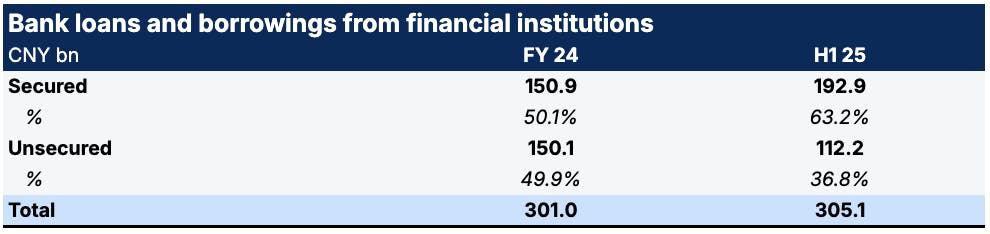
Vanke has approached banks seeking short-term loans or maturity extensions to ease pressure from its maturity wall, but at least two major local lenders have already rejected these requests. And the H1 25 bank loans and borrowings from financial institutions shows that while its total debt size has remained stable, the secured portion has increased from 50.1% to 63.2% — indicating its most appealing assets are likely already pledged as collateral.
Bondholders and restructuring teams are also attempting to ascertain whether Vanke’s stake in logistics company GLP has been pledged — or whether the asset could be retrieved in full by bondholders in the event of a default. “Everyone we speak to is focused on the GLP holding,” said one 9fin source, who was under the impression that at least as of December 2024, the holding wasn’t pledged.
With its controlling stake in Onewo pledged to Shenzhen Metro and many commercial assets sold or transferred through revitalisation and bulk-sale programs, Vanke has limited ability to offer additional collateral to banks when negotiating loan extensions.
Operational ability and project delivery may be one of the few arguments that Vanke could leverage when convincing banks to extend loans. Vanke ranked second among real estate developers in delivered units as of H1 25, and delivered 327 projects and 182,000 units in FY 24. In the first nine months of 2025, it delivered a total of 187 projects and 74,000 units. The company’s stable operational reliability could persuade banks to continue their support.
Shareholder support
In the past few years, Shenzhen Metro has played a crucial role in providing liquidity support to Vanke through sizeable loan support and asset purchases. As of Q3 25, Vanke stated that the cumulative shareholder loans from Shenzhen Metro reached CNY 29.13bn, with terms “better than market conventional levels” in both interest rates and loan-to-collateral ratios.
The question that everyone has been asking is: will Shenzhen Metro will rescue Vanke? Our view: Shenzhen Metro is willing to help Vanke sustain its operations to prioritise the delivery of housing units, but will not absorb open-ended losses and protect shareholders and creditors.
On the positive side, several directors and executives hold concurrent positions at both Shenzhen Metro and Vanke, including Vanke’s newly appointed chairman, who also serves as a director and general manager of Shenzhen Metro. But indeed, while that governance alignment may make it easier for Shenzhen Metro to steer Vanke’s operational restructuring, it does not imply it would underwrite the developer’s liabilities.
Shenzhen Metro also signed a framework agreement to provide Vanke a loan facility of up to CNY 22bn until H1 26. The funds can be used to repay bond principal and interest, as well as loan interest approved by Shenzhen Metro. We note that since Shenzhen Metro must make approvals before any repayments are made, the proceeds will likely be directed toward domestic liabilities rather than offshore debt.
On the negative side, Shenzhen Metro requested collateral for around CNY 20bn worth of previously unsecured loans in early November, which the market interpreted as Shenzhen Metro securing its own exposure ahead of other creditors. This shift indicates Shenzhen Metro is no longer simply a backstop equity holder, and that it has instead become a senior secured lender protected by collateral such as stakes in Onewo.
Given the Chinese government's priority on housing delivery, we believe Shenzhen Metro may continue to roll over shareholder loans, provide partial guarantees on onshore debt, or participate in asset and project transactions. However, it is unlikely they would absorb open-ended losses and protect creditors, since core assets of Vanke are pledged already and the government has emphasized a market-oriented approach to resolving the property sector crisis.