🍪 Our Cookies

This website uses cookies, pixel tags, and similar technologies (“Cookies”) for the purpose of enabling site operations and for performance, personalisation, and marketing purposes. We use our own Cookies and some from third parties. Only essential Cookies are used by default. By clicking “Accept All” you consent to the use of non-essential Cookies (i.e., functional, analytics, and marketing Cookies) and the related processing of personal data. You can manage your consent preferences by clicking Manage Preferences. You may withdraw a consent at any time by using the link “Cookie Preferences” in the footer of our website.

Our Privacy Notice is accessible here. To learn more about the use of Cookies on our website, please view our Cookie Notice.

3 to 30 minutes — The fallout of Prospect Medical’s bankruptcy

Share

News and Analysis

3 to 30 minutes — The fallout of Prospect Medical’s bankruptcy

  1. Samantha Kroontje
13 min read

Don’t miss out on distressed news you won’t find anywhere else — get The Memo US in your inbox every two weeks.

One afternoon in early June, Volunteer Medical Services Corps EMS responded to a shooting in Chester, Pennsylvania. The responders cut through traffic with a patient in the back of the ambulance, but the 19-year-old gunshot victim’s injuries were too severe to make the 25 minute drive west to the nearest emergency room.

“Three minutes versus almost 30,” VMSC paramedic Kate Denney said in an interview with 9fin, gesturing in the direction of a nearby hospital less than two miles away from the scene of the shooting — where her team would have taken their patient had Crozer-Chester Medical Center not been closed a couple of weeks before.

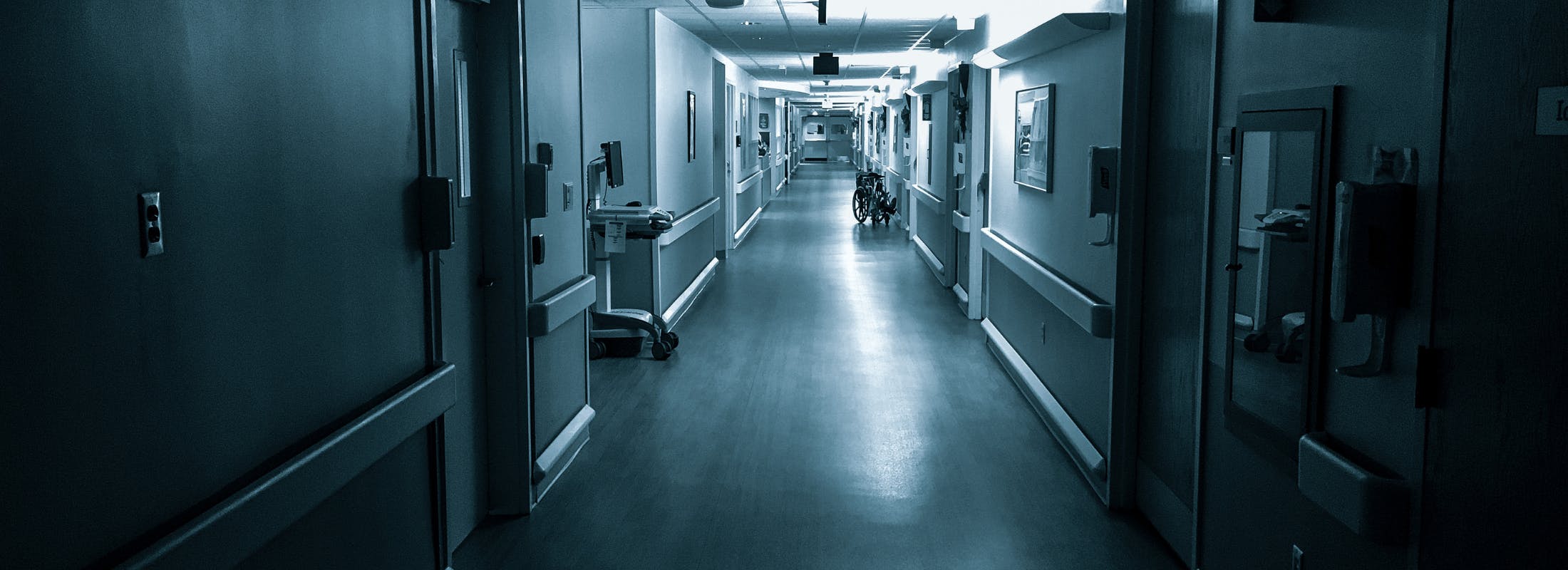
The cleared out hospital is owned by Crozer Health, which was until recently the largest healthcare provider and employer in Delaware County, just west of Philadelphia. It operated four hospitals in the county and a comprehensive portfolio of primary care practices in Pennsylvania before its parent, Prospect Medical Holdings, started shutting down operations of two of its hospitals in 2022 and closed the rest last spring after it filed for bankruptcy. Crozer-Chester was the last to go in May 2025, but loose bricks and shuttered windows make it look like the hospital has been boarded up for years.

Prospect Medical’s unraveling came after years of debt-fueled growth led by former private equity owner Leonard Green, compounded by lower patient volumes and cost pressures seen during the pandemic. The result is acutely felt in the rural and economically disadvantaged communities Prospect Medical was “dedicated to serving” through its 16-hospital portfolio across the US, which catered to patients who were mostly covered by Medicare and Medicaid programs.

More than 3,000 people were employed by the Crozer system alone, per Prospect Medical’s employment estimates, and many were jolted by the shorter-than-expected notice they received. Meanwhile, Delaware County’s roughly 577,000 residents were left with two distant hospitals: One out east close to Philadelphia and another in the middle, about a 20 minute drive from Chester without traffic.

Their access to critical care could worsen as the Trump administration’s Big Beautiful Bill, signed into law on 4 July, will likely result in $1.1trn in federal health spending cuts and nearly 12 million additional people uninsured over the next decade, according to estimates by the Congressional Budget Office.

A map of hospitals in Delaware County, Pennsylvania (shaded in blue). The yellow dots are open, non-Crozer hospitals and the red dots are closed. (Graphic: Dan Mika)

‘A graveyard’

Non-Crozer hospitals in and near Delaware County became inundated following the closures, the paramedic Denney said, citing up to two hour wait times to get patients out of ambulances for non-life-threatening cases. “As a result of that, we can't get back in service to take care of somebody who needs our help next.”

Meanwhile, the empty hospitals owned by Crozer were left with X-ray machines and a 1,200-gallon diesel oil storage tank on at least one of the properties, as mentioned in an 8 August hearing. After the Crozer-Chester closure, dozens of containers filled with various gases sat outside behind a wired fence.

Many of its outpatient facilities and specialty practices are also deserted. The Ridley Professional Building, a primary healthcare facility Christina Perrone, 66, built with her late husband in 2007, still sits empty after its Crozer staff was dismissed one by one throughout the spring. Crozer had leased most of the space in her building for 17 years, but broke its lease agreement with the local owner-operator three years early.

“It was a graveyard,” Perrone said.

Patients continue stopping by the abandoned building looking for their doctors or patient files. It’s a convenient location for Chester’s socioeconomically struggling population to access — across from a bus stop and shopping center on Chester Pike. Over 30% of Delaware County’s most populated city is in poverty, per The US Census Bureau, and it’s a high crime area.

Perrone is one of many awaiting payment after Prospect Medical defaulted, a consequence of mismanagement, financial maneuvers and years of losses. But recent court documents show unsecured creditors won’t be made whole.

At the onset of its bankruptcy, Prospect Medical identified around $473m of vendor claims and listed millions of dollars in cure costs to well over 100 contract holders just related to the Pennsylvania facilities, including suppliers, maintenance providers and landlords like Perrone, per a filing. A Disclosure Statement filed 19 August shows it owes nearly $3.8bn to general unsecured creditors who will get a pro rata share of a trust that’s funded by proceeds from some of Prospect’s litigation claims and recoveries. Prospect outlined the first $40m will go to those who rank higher in the repayment order, and whatever cash is left over will go into the trust. There’s a $10m minimum that will cover unsecured creditors claims and expenses, besides any deficiency claims tied to landlord Medical Properties Trust. Actual recovery figures haven’t yet been identified.

While Perrone was able to recoup around $100,000 after Prospect Medical filed, she claims she is still owed more than $470,000 for unpaid rent, legal fees, interest and damages for the broken lease agreement.

“They stopped paying their bills for heating and air conditioning systems, and I took over,” Perrone said, adding she still had mortgage responsibilities on the building. “They were supposed to pay me back.”

Conflicting interests

The financials of Prospect Medical’s pre-bankruptcy portfolio were largely managed by Leonard Green, its private equity owner between 2010 and 2021. Seeing opportunity in the around $5trn health industry, PE firms snapped up around 488 US hospitals as of March 2025, representing nearly 23% of for-profit hospitals and some of the country’s biggest hospital chains, according to the Private Equity Stakeholder Project. The short investment horizons and profit maximizing financial maneuvers typical of private equity can be at odds with the patient-oriented priorities in health systems.

Before Leonard Green bought its majority stake in 2010, Prospect Medical had nearly $300m in liabilities, as shown in documents released by the Senate Budget Committee and the results of its yearlong investigation. Its financial statements show that in 2016, the company raised a $625m loan and increased its borrowing capacity by replacing its revolver with a bigger ABL facility, which it partially used to buy the then non-profit Crozer Health and two separate health networks in Connecticut, paying hundreds of millions and committing hundreds more into future investments.

The Prospect Medical directors identified Crozer as a “target of interest” partially because of its $730m in revenues, per 2015 board minutes, and it assigned nearly $173m in goodwill value to Crozer shortly after the 2016 purchase.

Prospect Medical had five California hospitals in its 2010 inventory, per filings at the time. By the end of Leonard Green’s 11-year holding in 2021, it operated 17 hospitals and more than 162 outpatient facilities across five states, its website showed.

The acquisitions were in part funded by levering up the company, which also bankrolled dividends. A 2012 bond issuance allowed Prospect Medical to pay down debt and cover $88m of preferred stock Leonard Green pulled out, the documents show. The same year, it used a $100m add-on to its senior secured notes to pay investors a dividend of the same size.

To mark the end of its expansion blitz, Leonard Green issued $457m in dividends in 2018 by adding another $495m to Prospect Medical’s loan and again increasing access under its revolver to $250m from $175m, per the Budget Committee documents.

But challenges associated with the Covid-19 pandemic, supply issues and rising labor costs dragged down Prospect Medical’s revenue while bumping its expenses, according to its first day pleadings. It went from $10m in net income to nine-figure losses while its liabilities increased 11 times. At Crozer-Chester, annual losses ballooned from $2m when Prospect Medical bought it in 2016 to $132m in the red by 2023, the report shows.

But what culminated in a healthcare and logistical disaster for Delaware County was a windfall for its owners.

During Leonard Green’s ownership, Prospect Medical’s previous CEO Sam Lee personally received at least $112m in dividends, while current co-CEO David Topper pocketed $83m, based on their ownership percentage in 2010, at the time of the leveraged buyout.

Sam Lee and representatives at Prospect Medical did not respond to requests for comment, but the company told NBC News in January the Budget Committee left out its positive contributions and only reviewed documents at the corporate level, rather than from the hospitals that focus on care.

“Nearly all the hospitals Prospect acquired were cash-starved, neglected, in disrepair and on the verge of closure or bankruptcy,” Prospect Medical told NBC. “Prospect invested more than $750m in its hospitals and provided more than $900m in charity and uncompensated care to patients. That is the exact opposite of putting profits above patients.”

Source: Senate Budget Committee report

Source: Senate Budget Committee report

Convoluted ties

As Prospect Medical’s financial strains grew, its private equity owner introduced another complicating factor. A Leonard Green partner told the acquisitions team at Medical Properties Trust about its portfolio of 20 internally owned hospitals during a June 2018 meeting to discuss a potential sale-leaseback transaction, the REIT’s specialty, according to an MPT slide deck released by the Budget Committee.

The parties struck a deal the following summer, selling its hospitals to MPT for $1.55bn with the option to repurchase some of its real estate at the end of the lease, which would allow Prospect Medical to pay down its outstanding term loan debt. But the transaction stuck its hospitals with overwhelming lease responsibilities, totaling $116m per year.

The Crozer Health system became responsible for $34m of those annual rent payments, and Crozer-Chester’s profits deteriorated from $4m in 2019 to negative $132m in 2023. Delaware County Memorial Hospital’s losses nearly doubled to $25m over the same period.

Post transaction, Prospect Medical was left with $2bn in debt, per its September 2019 financial analysis. Two years later, Leonard Green pulled off its exit, selling its stake back to Sam Lee and David Topper for just $12m, paid by the company, plus the assumption of its lease obligations. 

Leonard Green did not respond to requests for comment, but a spokesman told The Wall Street Journal in January that Prospect Medical “was in strong financial condition with access to over $500 million to support its operations” when Leonard Green sold it in 2021.

By that time, the firm pocketed at least $525m, mostly in dividends, funded in part by adding nearly $2.8bn of liabilities to Prospect Medical, the Budget Committee’s investigation shows.

The Leonard Green spokesman also told The Journal its backing “enabled Prospect to invest in previously closed or failing hospitals, ensuring healthcare access for the underserved.”

Local public officials became inundated with complaints in the years after Leonard Green exited.

“It was like watching a train wreck in slow motion for the last four years,” Delaware County state Sen. Tim Kearney told 9fin.

Immediately after state Rep. Lisa Borowski was sworn into office in 2023, she started fielding calls from physicians. One explained they had to cancel the next day's procedures since there were no clean sheets at one of Crozer’s outpatient surgery centers because the company hadn’t paid the vendor. Another hospital employee said they didn’t have any syringes or scrubs.

The sale-leaseback transaction was the final blow to Crozer’s financial position, and a subsequent liability management exercise in 2023 left Prospect Medical more in debt to MPT than it was before, per a January hearing. Centerbridge and Blue Torch contributed a $375m term loan during the 2023 deal, leaving Prospect Medical $453m in debt to the investment firms when it filed. MPT kicked in a package of convertible notes that when combined with its remaining lease obligations, mortgage loan and term loan, added up to more than $1.7bn in obligations to MPT, versus $1.6bn before the deal.

Rapid unraveling

The Crozer Health system started to feel Prospect Medical’s financial strain. In 2018, The Centers for Medicare & Medicaid Services accused it of failing to maintain safety in its hospitals, with the potential to cause injury or death. Maintenance issues continued through to its 2025 bankruptcy.

“There was a lot of scrambling,” Tom Polizzi, a previous Crozer-Chester social worker, said. “And just trying to figure out how to manage the current crisis.”

Early during the Covid pandemic, Polizzi and his colleagues were directed to use their masks for two consecutive shifts — totaling 24 hours for some — but the mandate was quickly scrapped. Meanwhile, some nurses dressed in trash bags instead of gowns, well aware the hospital hadn’t been getting the personal protective equipment its staff needed. After the Covid lockdown, he noticed ceiling tiles falling due to a water leak in a supply room in the 1 West unit of the hospital, which he said continued to be an issue for quite a while. Throughout his five and a half years at Crozer, he’d seen leaks, unmaintained HVAC equipment and mold.

At Crozer EMS, employees operated a few ambulances with an excess of 250,000 miles driven and that were older than some of the people working on them, paramedic Kate Denney said. The heat didn’t work during the cold months and air conditioners failed in the summers, she added. Maintenance bills went unpaid, so when EMS vehicles started breaking down, Denney’s colleagues would step into mechanic mode between shifts and scour the left behind cruiser vehicles at their old station, what they also called ‘the graveyard’ — a nickname that proved to have myriad applications in this story — for parts they could use to repair their fleet.

Even with visible signs of operational issues, employees were caught by surprise when news started circulating that Prospect Medical requested to close its Crozer hospitals in early March.

“Happy employee appreciation day,” Crozer’s CEO Tony Esposito wrote to employees the day after the closure request was filed. “You are the foundation of everything we strive to achieve.” About a month and a half later, the company dropped rounds of termination letters.

“Everything was done within weeks,” Denney said. “We were told, you’re going to have jobs, and then we get a 10-day notice.” Employees expected more time — Pennsylvania law requires 90-days if EMS services are being cut or reduced. Plus, it takes months to wind down a hospital and transition patient care, the chiefs of all Crozer residency programs wrote in a March letter. “A sudden closure would be dangerous for countless patients.”

Healthcare workers gathered across the street from Crozer-Chester on 2 May 2025, the hospital’s last day open, to piece together which colleagues had started looking for work and who planned on leaving the area.

Tom Polizzi heard one of his patients ended up at Lancaster General Hospital, which he figured was nearly a two hour drive away.

“A lot of people were concerned about what was going to happen next to them,” Polizzi said. The closure threw their plans into disarray — when Prospect Medical purchased Crozer in 2016, it agreed to keep the hospitals open for at least 10 years and under the asset purchase agreement, committed to ensure Delaware County residents had access to “a full range of healthcare services.”

Still, when Crozer-Chester shut its doors, many employees assumed a new owner would step in and maintain the hospitals.

Source: Senate Budget Committee report

Uncertain future

The idea was Prospect Medical would keep Crozer hospitals’ lights on and fend off deterioration until another health system saw opportunity in the drab buildings and restored their services. But with few bids on the table, others are seeing demolition as the safest route.

Prospect Medical is abandoning two of its hospitals — Delaware County Memorial, just west of Philadelphia, and Taylor Hospital in Chester — after Judge Stacey Jernigan approved its 25 July request.

Just acclimating to the healthcare void, community members worry about a catalogue of new potential hazards the boarded up buildings could introduce if abandoned. The Upper Darby Township cited prospective breakdowns in left behind plumbing, wiring, gas lines, ventilation systems and the structural stability of the buildings themselves — concerns exacerbated by trespassers. Though, the court order requires Prospect Medical to maintain fire suppression systems and “reasonable security.”

While Prospect Medical has not disclosed active offers on the table for the rundown Crozer-Chester or Springfield Hospital, a third-party buyer expressed interest in Taylor Hospital, which Prospect Medical’s counsel was not able to provide more details on during a 4 August hearing. Both bids for the hospitals — described by its parent company as underwater — have fallen short of the worth of tax claims by millions of dollars, and Prospect Medical is abandoning the buildings whether the sales are successful or not.

Some of Crozer’s other facilities were successfully auctioned off to a neighboring health system, but many were left behind — including the primary healthcare facility Christina Perrone owns.

Her building looks inviting, especially compared to the hospitals nearby. But in the doctors’ offices up the stairs, front desks are chairless and medicine cabinets were left open and empty after Crozer cleared out its equipment, leaving behind spreads of scrap paper, stray cords and dozens of boxes holding unclaimed patient files.

A woman who looked like she was in her 70s or 80s walked through the doors of the building and Perrone peered over to greet the latest patient lost in Delaware County’s healthcare desert. “You can help me?” the woman asked. “I have to find a doctor.”

What are you waiting for?

Try it out
  • We're trusted by the top 10 Investment Banks