This guide is part of our webinar series on building AI workflows. To explore all our sessions, click here.
I’m a legal data analytics consultant at 9fin. Here’s how I analyze and benchmark new notes against recently sponsored deals, using AI to shave my time on this task down from hours to minutes.
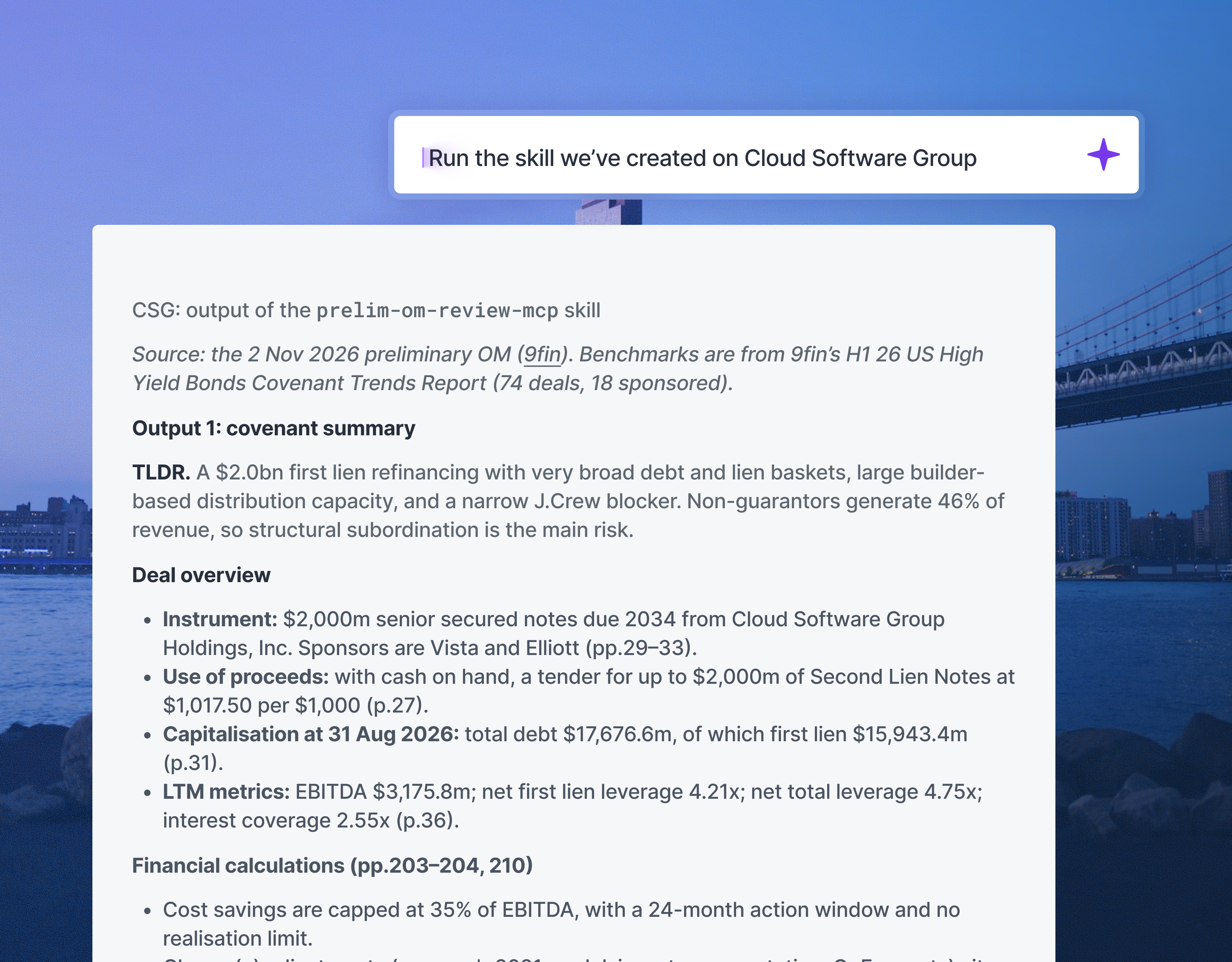
At the end of the process, I end up with a skill I can re-run on new deals whenever I need — and without all the prompting! I use this skill to benchmark covenant terms, flag unusual provisions, and turn a draft document into sourced, annotated analysis, ready to send.
Here’s a snippet of what I end up with.
But first: how does AI help?
Analysing covenants takes time. You need to locate the documents, understand how the covenants in front of you compare to the current market standard, and sometimes dive deep into bespoke clauses.
It’s repetitive, manual work, spread across multiple platforms and resources — and all of this means late nights working on something that could easily be partially automated.
But now, you can use the AI assistant of your choice connected to 9fin’s MCP to complete your entire workflow, all within the comfort of a chat interface.
Let’s get into what that looks like, using Cloud Software Group as our example.
Objective 1: to pull and analyze the covenants
The prompt: Using 9fin's MCP, can you summarise the covenants for Cloud Software Group's November 2026 preliminary offering memorandum? Please copy the style and sections covered by the team's legal QuickTakes.
The output: I get a comprehensive covenant analysis, entirely drawn from the source document, inspired by 9fin’s Legal QuickTakes. With very little prompting, you can produce a summary covering all the sections you care about: restricted payments, debt, blockers, EBITDA adjustments, and more.
Taking a closer look
My AI assistant is able to provide a high level of detail from a very simple prompt. The output also includes all the baskets that could be used for dividends or value leakage, set out in a table just like our QuickTakes.
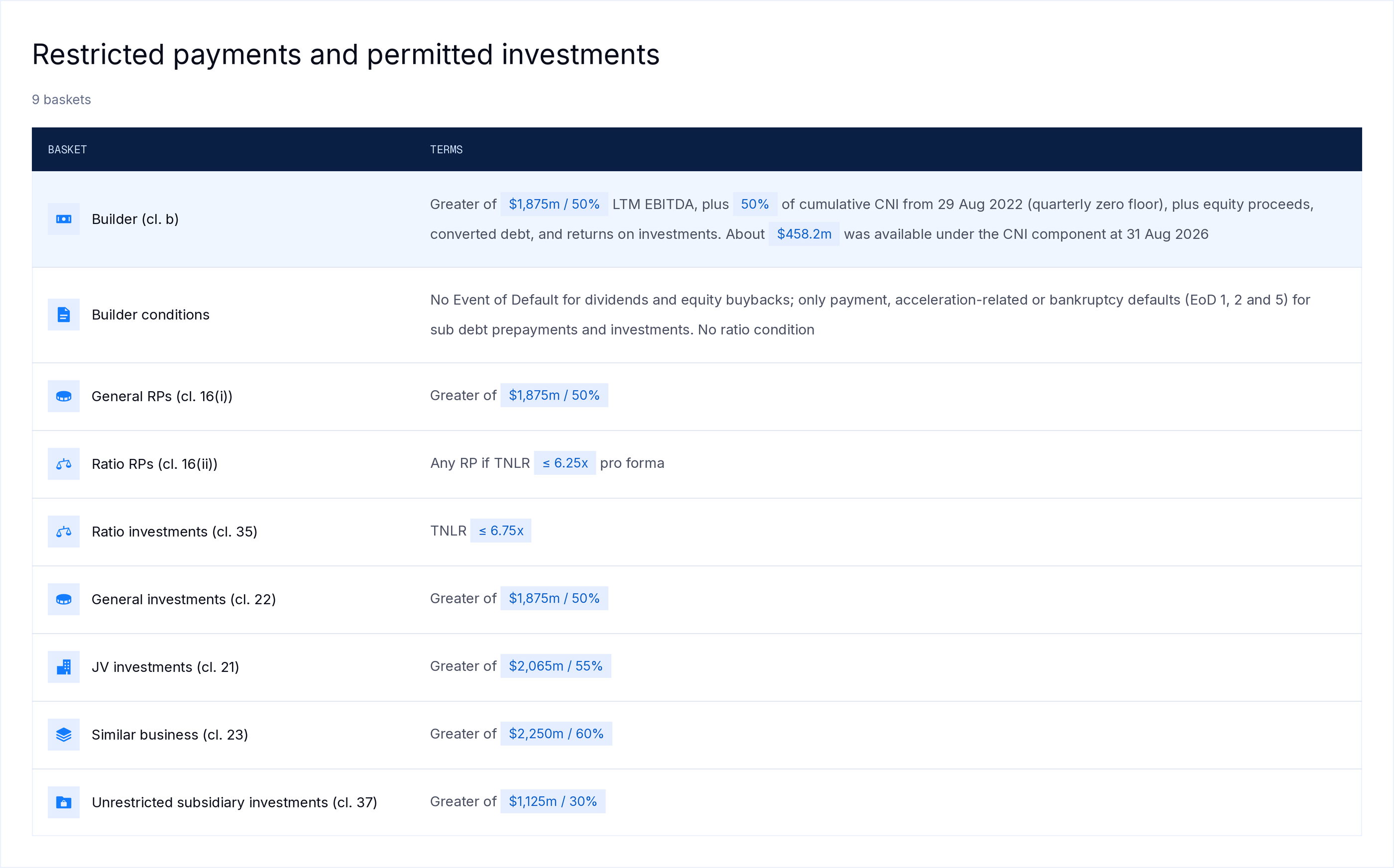
Looking at the numbers, you can tell that:
- The builder basket is calculated based on a “quarterly zero floor” formulation
- It’s backdated to 2022, which means there’s $458m of capacity at the time of writing
- There’s a reallocation basket, so investments can be increased by the Available RP Capacity Amount
Objective 2: to benchmark against the market
The prompt: Compare the terms of CSG's covenants to what's standard in US-sponsored deals.
The output: I get a clear side-by-side analysis of how the deal’s covenants compare to the sponsor-backed HY deal universe, pulled from our bonds and loans trends reports published every six months.
Objective 3: to explore specific clauses
The prompt: Pull the J.Crew blocker and explain what protection it provides me in a downside scenario.
The output: I get the full blocker text and relevant definition, with page references. The response breaks down how the J.Crew blocker protects me, and, more importantly, where it might fall short.
Worth noting that AI generates analysis from two types of 9fin content.
Firstly, our legal summaries (QuickTakes), which include 9fin commentary on J.Crew blockers. The AI assistant can use these to understand what matters for lender protection. And secondly, our ad hoc educationals on specific concepts and trends in the market.
Objective 4: to create a list of pushback points
The prompt: Make a list of five points in these covenants to push back on as a lender.
The output: I get a list of five provisions to amend, with a clear explanation as to what amendment I should ask for — in this case, the five points include adding a non-guarantor debt cap, amending the J.Crew blocker, limiting 'no worse' ratio debt to acquisition debt, removing the quarterly zero floor, and reducing the EBITDA add-back cap to 25%.
Taking a closer look
The first point concerned adding a non-guarantor debt cap. What I find impressive about this is that it contextualises the suggestion by flagging that non-guarantors actually accounted for 46% of the business’s revenues.
This detail was pulled from 9fin’s financials.
The suggestion makes a lot of sense given the generous 100% EBITDA non-guarantor debt basket, which the assistant had already identified as being off-market in the output.
Objective 5: to create a skill so you can reuse this output in the future
The prompt: Turn this conversation on CSG into a skill I can reuse. Specifically, I want a summary of the covenants, a table comparing the covenants to the wider market, and a list of five points to push back on as a lender.
The output: I get a skill based on my specifications that I can reuse by simply naming a company and a preliminary offering memorandum.
The result? Covenant analysis in one chat
I now have a preliminary offering memorandum skill based on 9fin’s MCP that I can reuse next time a new deal comes up. All I’ll have to do is drop the name of the company and the preliminary offering memorandum and it will produce those three outputs.
I also talked through this whole workflow in even greater detail in the first webinar in our MCP series — access the replay here.
And head over here for more on 9fin’s MCP.